
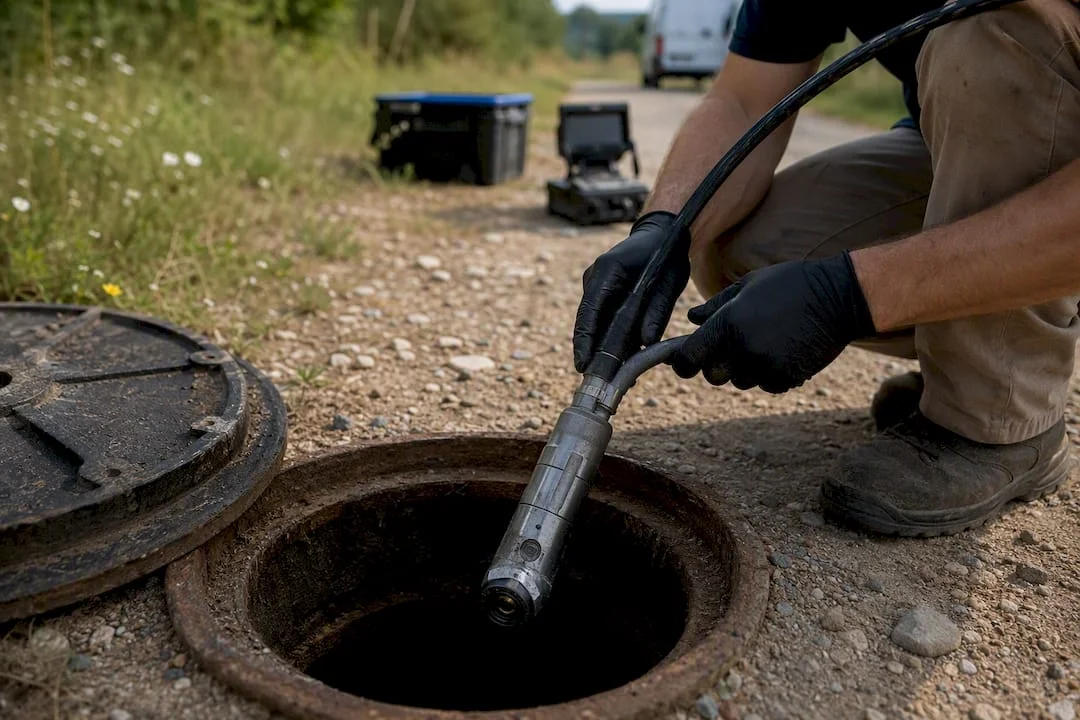
Commercial property sewer video documentation is a timestamped HD inspection package, including full video, extracted still images, distance and depth markers, and a written defect summary with severity ratings and inspector contact information. You need it in three situations:
- Due diligence. Before you buy or lease a commercial building, you want proof the sewer lateral isn’t a six-figure surprise waiting to happen.
- Emergency triage and insurance. A backup or collapse needs an objective, timestamped record to support your claim.
- Planned capital projects. You want hard evidence, not guesswork, before budgeting a lining or replacement job.
Because it’s timestamped and shareable, this footage holds up as documentation for insurers, lenders, and tenants alike.
Key Takeaways
Complete commercial sewer video documentation combines timestamped HD footage, distance and depth data, and a written severity-ranked summary that supports repair decisions, insurance claims, and capital planning.
| Point | Details |
|---|---|
| Confirm full deliverables | Require timestamped HD video, extracted stills, distance markers, and a written summary with inspector contact. |
| Ask about RF locating | Depth and surface marking from an RF sonde prevents guesswork on complex or unmapped laterals. |
| Match report to standards | Municipal submittals typically require site address, inspection date, contractor contact, and a unique inspection ID. |
| Use severity tiers to prioritize | Sort findings into immediate, near-term, and monitor categories before committing budget. |
| Pair documentation with trenchless repair | Trenchlessmaine uses video and RF locating findings to scope CIPP lining and other low-disruption fixes for commercial lines. |
Table of Contents
- What Goes Into Complete Commercial Property Sewer Video Documentation
- Why Documented Video Inspections Pay Off for Commercial Owners
- What Happens During a Commercial Sewer Inspection?
- Do Sewer Video Reports Need to Meet Municipal Standards?
- How to Prepare for an Inspection and What to Ask Vendors
- What Drives the Cost and Timeline of Commercial Sewer Documentation?
- Reading the Report: Common Defects and What They Mean
- From Footage to Fix: Turning Documentation Into a Repair Plan
- A Publisher’s Take on Commercial Documentation
- How Trenchlessmaine Documents and Repairs Commercial Sewer Lines
- Frequently Asked Questions
- Sources
What Goes Into Complete Commercial Property Sewer Video Documentation
A complete package gives you more than a video file you’ll never open again. Expect these components from any provider worth hiring:
- Full HD video with visible timestamps, plus a shareable streaming link so you don’t have to email a massive file.
- Extracted still frames of every defect, labeled and referenced to a location in the line.
- A written summary listing your inspection ID, site address, date, and the inspector’s contact information.
- Distance-from-access measurements, usually from a footage counter on the camera reel, showing exactly where each defect sits.
- RF sonde depth and surface marks, when locating was performed, tying underground defects to a spot on your property map.
- Defect descriptions with severity ratings, a prioritized action list, and notes on pipe material, diameter, and any transitions between pipe types.
Ask about raw data export up front. Most commercial providers deliver archive-quality .mp4 or .mov files alongside .jpg or .png stills, formats any contractor or engineer can open without special software. CCPIA’s guidance on commercial sewer scope inspections outlines similar reporting templates as a baseline for what a professional deliverable should include.
Why Documented Video Inspections Pay Off for Commercial Owners
Objective footage changes how every downstream decision gets made. Here’s where it earns its cost back:
- Transaction due diligence uncovers pre-existing defects before closing, not after.
- Tenant and multi-tenant chargebacks get resolved faster when footage shows exactly whose line failed and why.
- Insurance claims move quicker with timestamped video as evidence of pre-loss or post-loss conditions.
- Contractor bidding gets more accurate. Bidders quoting off real footage submit fewer change orders than bidders quoting off a verbal description.
- Planned replacement scheduling lets asset managers rank projects by actual severity instead of age alone.
Owners, facilities teams, and lenders reviewing capital plans all lean on the same record. One industry practitioner treatment of commercial laterals frames the inspection as a due diligence line item rather than an optional extra, particularly for older buildings.
What Happens During a Commercial Sewer Inspection?
A commercial job moves through five stages, and knowing them ahead of time helps you plan access and avoid delays.
- Access and site prep. The crew locates cleanouts, protects flooring, manages foot or vehicle traffic, and confirms which access points are usable.
- Video scoping. A push or crawler camera records continuous HD footage while the technician logs pipe material, diameter, and any transitions between pipe types.
- RF sonde locating (optional but recommended). A sonde inside the camera head transmits a signal to a surface locator, marking depth and horizontal position for complex or unmapped laterals.
- Analysis. Back at the office, the technician codes each defect, assigns a severity level, and builds a prioritized recommendation list.
- Delivery. You receive the shareable report, raw video files, extracted stills, and a locator map if sonde work was done.
Pro Tip: Ask whether RF locating is included or billed separately before the crew arrives. Skipping it on a long or branching lateral often means guessing at depth later, which costs more than the add-on would have.
Confirm your acceptance criteria before the job starts: continuous footage with no gaps, legible timestamps, and file formats you can actually open. Trenchlessmaine’s underground locating service covers this kind of RF sonde work as a standalone add-on when a straight camera run isn’t enough.
Do Sewer Video Reports Need to Meet Municipal Standards?
Yes, if you plan to submit the report to a city or use it for permitting, and the bar is lower than most owners expect. Portland’s BES guidance requires video inspections to identify the site address, the inspection date, and the video contractor’s contact information, along with specific expectations for submitting video, photo, and map files together.
At minimum, expect your report to include:
- Site address and inspection date
- Inspector or contractor contact details
- A unique inspection ID for reference
- Continuous, timestamped footage runs with distance markers
- Still-frame extractions of any defects
- RF locating metadata, when that service was performed
If your documentation needs to feed into a larger capacity study, the EPA’s SSOAP toolbox includes a Condition Assessment Support Tool built to prioritize sub-sewersheds using exactly this kind of field data.
How to Prepare for an Inspection and What to Ask Vendors
A little prep work keeps the crew moving and keeps your costs predictable. Before the truck arrives:
- Locate and label all known cleanouts.
- Clear parking or staging space for the inspection vehicle.
- Protect flooring near interior access points.
- Notify tenants if access runs through occupied space.
When comparing vendors, ask directly:
- What camera resolution do you record at, and in what file format?
- Do you offer RF sonde locating, and is it included?
- What’s your typical reporting turnaround?
- Can you show a sample deliverable before I sign?
- What defect-coding standard do you use?
- Are you insured, and what warranty applies to locating accuracy?
Walk away from any provider who offers only verbal findings, won’t hand over raw video, or can’t produce a sample report on request. If your organization procures through cooperative contracts, Sourcewell’s purchasing listings show how public entities standardize inspection equipment specs, a useful reference point even for private commercial buyers drafting an RFP.
What Drives the Cost and Timeline of Commercial Sewer Documentation?
Pricing depends less on the property’s size and more on what the line actually demands. The main cost drivers:
- Total pipe length and diameter
- Site access complexity (buried cleanouts, tight crawl spaces, multiple buildings)
- Whether RF sonde locating is needed
- Number of laterals and cleanouts on the property
- HD versus specialty crawler camera requirements for larger-diameter lines
- Report customization, including coded defects and specific export formats
A single-run scope on a small commercial building might wrap in an afternoon with a report in a day or two. A full campus survey with multiple buildings and laterals can run several days on-site with a report delivered a week or more later. Add-ons like hydro-jetting before scoping, since a clean line records far better footage, an engineering review, or full depth locating all add cost, but they also add usable data you’ll want on hand later.
Reading the Report: Common Defects and What They Mean
Most commercial reports fall back on a handful of recurring defect categories, and knowing them helps you prioritize without waiting on a callback.
- Root intrusion shows up as hair-like or web-like growth breaching a joint, usually flagged for near-term cleaning or repair.
- Grease buildup narrows the pipe’s usable diameter and is common in food-service lines, often resolved with hydro-jetting.
- Offsets and bellies appear as a visible dip or misalignment where water pools instead of flowing through, a signal worth monitoring closely.
- Cracks and fractures range from hairline to structural, and severity determines whether it’s a monitor item or an immediate repair.
- Corrosion and collapsed segments are the most serious findings, typically triggering an immediate repair recommendation.
Reports generally sort findings into three tiers: immediate (emergency repair), near-term (planned lining or spot repair within months), and monitor (recheck on a set schedule). Cleaning and hydro-jetting handle grease and minor root issues; CIPP lining addresses cracks, offsets, and moderate corrosion without excavation; full collapse or severe structural failure usually calls for an engineering evaluation before any repair method gets chosen. Background on common failure modes is worth a read if you want more detail on why these defects form in the first place.
From Footage to Fix: Turning Documentation Into a Repair Plan
A qualified trenchless specialist doesn’t stop at handing you a report. The real value shows up in the sequence: video, then locate, then prioritize, then match the defect to a repair method, CIPP lining or sliplining where the line qualifies, before any excavation gets discussed. That order keeps disruption and cost down.

When you’re vetting a repair vendor off your inspection report, ask for project warranties, materials guarantees, and specifics on how trenchless methods reduce site disruption compared to dig-and-replace. That same documentation also gives insurers, investors, and CapEx committees a clean paper trail from finding to fix, something a partner resource on inspection reporting covers well for readers building out formal submittal packages.
A Publisher’s Take on Commercial Documentation
Trenchlessmaine builds every commercial job around HD camera inspection first, because a repair plan is only as good as the footage behind it. Pairing that footage with RF locating and trenchless repair options, backed by warranties up to 50 years, lets commercial clients fix problems without tearing up a parking lot or a lobby floor. Before you hire anyone, ask for a sample deliverable and confirm RF locating is on the table.
How Trenchlessmaine Documents and Repairs Commercial Sewer Lines
Trenchlessmaine handles the full arc, from HD camera scoping through RF locating to trenchless repair, so you’re not juggling three separate vendors for one sewer problem. That matters most on commercial properties where downtime and disruption carry a real cost.

Our sewer scope inspection service delivers the full documentation package described above: timestamped HD video, extracted stills, and a written severity summary you can hand straight to an insurer or a lender. Turnaround is fast, often within a day or two, and RF locating or hydro-jetting can be added when a line needs cleaning before it records clearly. If findings point toward a repair, we can scope CIPP lining or other trenchless fixes off the same footage, no second inspection needed. Call Trenchlessmaine or fill out a contact form to schedule your commercial inspection and get a sample report before you commit.
Frequently Asked Questions
What is included in commercial property sewer video documentation?
A complete package includes timestamped HD video, extracted still images of each defect, distance and depth measurements, and a written summary with severity ratings, an inspection ID, and inspector contact information.
How long does a commercial sewer video inspection take?
A single building with a straightforward lateral often wraps in a few hours, with a report delivered within a day or two. Multi-building campuses with several laterals can take several days on-site and a week or more for the full report.
Do I need RF sonde locating for every inspection?
Not always, but it’s strongly recommended for long, branching, or unmapped laterals where you need an accurate depth and surface position to plan a repair.
Can this documentation be used for insurance claims?
Yes. Timestamped, dated video with a written summary is exactly the kind of objective record insurers expect to support a claim or document a pre-existing condition.
What should I do if the report shows a collapsed segment?
Treat it as an immediate repair item and get an engineering evaluation before choosing between spot repair, CIPP lining, or excavation, since a full collapse can affect nearby soil and structures.

Sources
For deeper technical grounding beyond this guide:
- Sanitary Sewer Overflow Analysis and Planning (SSOAP) Toolbox | US EPA
- Sewer Video, Photo, and Map Guidelines
- Commercial Sewer Scope Inspections
Loop in a municipal reviewer or engineer whenever findings will support a permit filing or a major capital decision.