
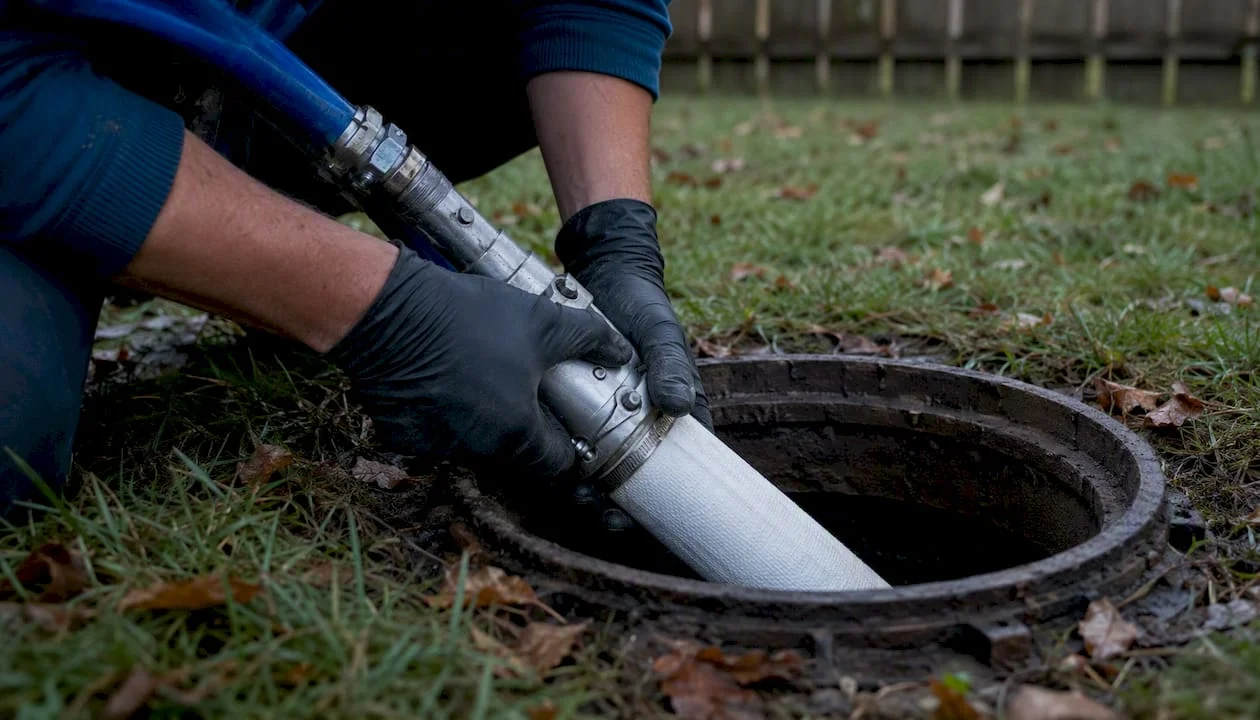
A new or upgraded sewer or septic system rarely pays for itself dollar for dollar, but it protects the sale price you already expect to get. Whether the upgrade actually boosts what you walk away with depends on your local market, the age and documentation of the system you’re replacing, and how much it costs to connect versus what buyers in your area will pay for it.
In suburban markets, homes on public sewer sell for roughly 2% to 11% more than comparable homes on private septic. In rural areas, where septic is the norm, that premium often shrinks to nothing.
Three things determine where you land on that range:
- Local norms — is everyone around you on septic, or is public sewer the expectation?
- System condition — an aging, undocumented tank scares buyers more than the type of system itself.
- Connection cost versus premium — if hooking into the sewer main costs more than the price bump you’d earn, it’s not worth doing before a sale.
Key Takeaways
A sewer or septic upgrade protects your sale price by removing buyer risk more reliably than it adds a matching dollar increase to your listing price.
| Point | Details |
|---|---|
| Premium is market-dependent | Suburban sewer connections often add 2% to 11% in value; rural markets show little to no gap. |
| Documentation beats age | A well-documented septic system often outperforms an undocumented “upgraded” one in buyer confidence. |
| Trenchless preserves value twice | It protects landscaping during the job and gives buyers a long warranty they can trust. |
| Run the ROI math before committing | Total all costs, apply your local premium percentage, and compare against non-financial benefits like a faster close. |
| Trenchlessmaine documents the work | Camera inspections, CIPP lining, and warranties up to 50 years give sellers the paper trail buyers expect. |
Table of Contents
- What Market Data Says About Sewer Upgrades and Property Value
- What Determines Whether Your Upgrade Pays Off
- What Do Sewer and Septic Upgrades Typically Cost?
- How Do You Calculate Real ROI on a Sewer Upgrade?
- How Long Does a Sewer or Septic Upgrade Take?
- Should You Upgrade Now, Delay, or Just Disclose?
- How Should You Document and Market a Sewer Upgrade?
- How Do You Vet a Sewer Contractor Before Hiring?
- The Overlooked Truth About Sewer Upgrades and Resale Value
- Get a Sewer Upgrade That Actually Protects Your Sale Price
- Frequently Asked Questions
- Sources
What Market Data Says About Sewer Upgrades and Property Value
Hedonic pricing studies (models that isolate how one feature affects sale price while controlling for everything else) consistently find that public sewer connection carries value in suburban and urban comps, but the effect flattens out in rural markets where septic is standard and well understood. The Massachusetts data putting the suburban sewer premium at 2% to 11% is the most frequently cited benchmark, and it lines up with what appraisers report anecdotally across similar Northeast housing stock.
Municipal conversion programs back this up from the policy side. Miami-Dade County’s District 1 Septic to Sewer Conversion Program states plainly that centralized sewer connections can enhance property value, which is part of why the county subsidizes connections in vulnerable neighborhoods rather than leaving owners to absorb the full cost.
The historical extreme case comes from 19th-century Chicago, where a quasi-experimental study found that piped water and sewer access more than doubled land values in treated parcels, with benefits far exceeding construction costs. That gap reflects a world without modern septic engineering, so treat it as historical context, not a modern return rate.
| Metric | Typical range | Source |
|---|---|---|
| Suburban sewer premium | 2%–11% | Mass.gov |
| Rural sewer premium | Near zero | Mass.gov |
| Plumbing/system upgrade value bump | 3%–5% | EngineerSkill.blog |
| Historical infrastructure land value effect | Over 2x (19th-century Chicago) | Coury et al. |

What Determines Whether Your Upgrade Pays Off
Not every upgrade moves the needle the same way. A few variables decide whether you’re buying real equity or just avoiding a future headache.
- Local market expectations. If every comp on your street is on septic, a sewer connection won’t move price much because buyers aren’t comparing you against sewer-served homes.
- System condition and documentation. A tank with pumping receipts and a recent camera scope reads very differently to a buyer than one with no paper trail at all.
- Distance to the sewer main. Lateral length, driveway crossings, and whether the municipal line even reaches your street change your cost basis dramatically.
- Regulatory triggers. Some towns require a septic inspection or mandatory sewer hookup at time of sale, which can force your hand regardless of ROI math.
- Buyer risk perception. Buyers aren’t just paying for pipe. They’re paying to avoid inheriting a problem they can’t see, and that risk discount often costs sellers more than the repair itself would have.
Pro Tip: Pull your town’s sewer availability map before you spend a dollar on connection quotes. Some municipalities publish these online, and knowing whether the main even runs near your lot saves you from paying an engineer to tell you the obvious.
For a deeper look at how buyers weigh septic versus sewer before making an offer, see our guide to septic vs. sewer in Maine.
What Do Sewer and Septic Upgrades Typically Cost?
The right fix depends on what’s actually failing. Here’s the practical menu, roughly ordered from smallest to biggest financial commitment.
| Upgrade type | Typical scope | Cost driver |
|---|---|---|
| Camera inspection + hydro jetting | Diagnose and clear blockages | Line length, access points |
| Septic pumping/repair | Routine maintenance or minor fix | Tank size, accessibility |
| Drain-field replacement | Rebuild the leach field | Soil type, permit fees |
| Trenchless lining (CIPP) | Rehabilitate an existing pipe from inside | Pipe diameter, condition |
| Sewer lateral connection | Tie into an existing public main | Lateral length, trenching |
| Full lateral replacement (open-cut) | Dig and replace the entire line | Excavation, restoration, permits |
| Advanced treatment unit (ATU) | Replace conventional septic with engineered treatment | Site constraints, equipment |
Cost drivers repeat across almost every option: soil conditions, how far the pipe has to run, whether you’re crossing a driveway or landscaping, and permit fees that vary by town.
Trenchless methods like cured-in-place pipe (CIPP) lining tend to hold up better on resale packets because they avoid tearing up a yard, and they carry documented service lives that appraisers can point to as a genuine risk reducer. A modern renovation method that preserves landscaping and comes with a long warranty tends to read to buyers as a finished problem, not a work in progress.

Pro Tip: If your existing pipe is structurally sound but has one bad section, a targeted trenchless repair almost always beats a full replacement for resale purposes. Buyers care that the problem is solved and documented, not that you replaced every foot of pipe.
How Do You Calculate Real ROI on a Sewer Upgrade?
Start by listing every cost, not just the contractor’s line-item bid.
- Direct construction or connection cost.
- Permit and inspection fees.
- Landscaping and site restoration.
- Ongoing sewer bills versus what you were paying for septic maintenance.
- Any carrying or financing costs if you’re borrowing to fund the work.
Then run the math against your local premium. That’s roughly $21,000 in added value against a $12,000 spend, a solid net gain even before accounting for a faster, less contentious sale.
- Total every cost above, not just the headline quote.
- Apply your local premium percentage to your home’s likely sale price.
- Subtract cost from expected premium for your net.
- If the number is close to zero, weigh the non-financial upside: fewer inspection fights, a faster close, less buyer walk-away risk.
How Long Does a Sewer or Septic Upgrade Take?
Most projects follow the same sequence: a camera inspection to confirm what’s wrong, design and permitting, the excavation or trenchless work itself, connection and final inspection, then site restoration and paperwork.
- Small repairs or hydro jetting: often same-day to a few days.
- Trenchless lining: frequently completed within 24 hours of the actual lining work, though permitting can add a week or two upfront.
- Full sewer connection: typically several weeks once permits clear, longer if the municipal main isn’t close.
Permit lead times vary by town, and some municipalities run assistance programs similar to Miami-Dade’s conversion initiative that help offset connection costs for qualifying properties. Check with your local public works office early. Larger municipal upgrade projects benefit from coordinated planning that sequences work to reduce delays and cost, and that same logic applies at the household level.
Pro Tip: If you’re planning to list within the next year, schedule permit applications the moment you decide to upgrade. Permit backlogs are the single biggest reason sellers miss their target listing date.
Should You Upgrade Now, Delay, or Just Disclose?
- Upgrade now if: the system is failing, your town mandates connection, a subsidy program is available, or connection cost is low relative to your local premium.
- Delay or disclose if: the system is relatively new with good maintenance records, connection cost is high, or you’re in a rural market where septic is the norm and buyers don’t discount for it.
- As a buyer, insist on seller action for a failing or undocumented system, but accept a well-maintained septic system backed by pumping records and a recent inspection.
- Negotiation tip: a documented, working system removes leverage buyers would otherwise use to demand a credit during inspection contingencies.
How Should You Document and Market a Sewer Upgrade?
Buyers pay for certainty. Give them a packet with inspection reports, camera-scope video, pumping receipts, permit copies, warranties, and your installer’s contact information.
- List the work specifically: “new sewer lateral installed 2025” or “CIPP-lined main line, 50-year warranty” reads as finished, not vague.
- A recent sewer scope inspection removes the single biggest source of last-minute negotiation.
- Bundle a short written warranty or transferable maintenance plan whenever your contractor offers one.
Pro Tip: Video footage from before and after the repair is worth more in a listing packet than a paragraph of description. Buyers trust what they can see.
How Do You Vet a Sewer Contractor Before Hiring?
Verify license and insurance before anything else, and ask for references along with before-and-after documentation from past jobs. Confirm warranty terms in writing and make sure the contractor can actually perform camera inspections, not just estimate blind.
- Red flags: a vague scope of work, no written warranty, reluctance to show past inspection footage, or a bid with no line-item detail.
- Trust signals: signed permits, manufacturer warranties on liner materials, a written restoration plan, and clear payment milestones tied to progress.
A camera-scope video taken before and after the work, kept in your sale packet alongside the warranty paperwork, does more to protect your asking price than almost any other single document a seller can produce.
Pro Tip: Ask for two videos, not one. A pre-repair scope proves the problem existed, and a post-repair scope proves it’s gone. Buyers and their inspectors respect that pairing.
The Overlooked Truth About Sewer Upgrades and Resale Value
Most homeowners ask the wrong question. They want to know if a sewer upgrade will raise their asking price, when the more useful question is whether skipping it will lower it. The data backs that framing: a documented, functioning system rarely earns a premium in rural markets, but an undocumented, aging one almost always costs sellers something at the negotiating table.
The conventional advice treats sewer and septic work like a kitchen remodel, something you do to increase value — for more on which home improvements typically move price, see our guide to upgrade your home’s value. That’s the wrong model. This is closer to insurance. You’re not buying a higher number on the appraisal. You’re buying out the risk that a buyer’s inspector finds something scary enough to knock five figures off your price or kill the deal outright.
What should you prioritize first? Documentation, not construction. Before you spend a dollar on excavation, get a camera scope and pumping records in hand. Half the homeowners who assume they need a full replacement actually need is a paper trail and maybe a targeted trenchless repair. Spend your money proving the system works before you spend it rebuilding one that might already be fine.
Get a Sewer Upgrade That Actually Protects Your Sale Price
If you’ve read this far, you already know a sewer upgrade isn’t about chasing a percentage on paper. It’s about closing the deal without a five-figure concession. Trenchlessmaine handles that the way appraisers and buyers respond to best: trenchless repairs that skip the excavation, finish most jobs within 24 hours, and come backed by warranties running up to 50 years.

That combination matters most right before a listing goes live, when you don’t have months to spare for a torn-up yard or a permit backlog. Whether you need a full trenchless sewer repair to replace an aging lateral, a targeted slip lining fix for one bad section, or a camera inspection to build the documentation buyers expect, Trenchlessmaine handles Maine properties across residential, commercial, and municipal work. Get a scope done first and you’ll know exactly what you’re dealing with before you spend a dollar on repairs. Request a quote today and find out what your property actually needs before you list it.
Frequently Asked Questions
Does a sewer system upgrade always increase property value?
No. It rarely adds a dollar-for-dollar increase. It more commonly prevents a price reduction or negotiation credit caused by a failing or undocumented system, and in suburban markets it can add a measurable 2% to 11% premium over comparable septic homes.
How much does connecting to public sewer typically cost?
Costs vary widely based on lateral length, soil conditions, and whether you’re trenching through a driveway or landscaping. Trenchless connection methods often cost less overall once you factor in restoration compared to full open-cut excavation.
Is a septic system a dealbreaker for buyers?
Not in markets where septic is standard. A well-maintained system with pumping records and a recent inspection is usually accepted at face value, especially in rural areas where sewer isn’t the norm.
What documents should sellers gather before listing a home with sewer or septic work done?
Inspection reports, camera-scope video, pumping receipts, permit copies, contractor warranties, and installer contact information. These remove the uncertainty that drives buyers to ask for price concessions.
Are trenchless repairs treated differently by appraisers than traditional excavation?
Trenchless methods like CIPP lining preserve landscaping and often carry long service-life warranties, which some appraisers and buyers treat as a meaningful risk-reduction factor even without a formal valuation adjustment.
This article is general information, not a substitute for advice from a qualified financial advisor. Consult a qualified financial professional about your own circumstances before acting on anything here.