
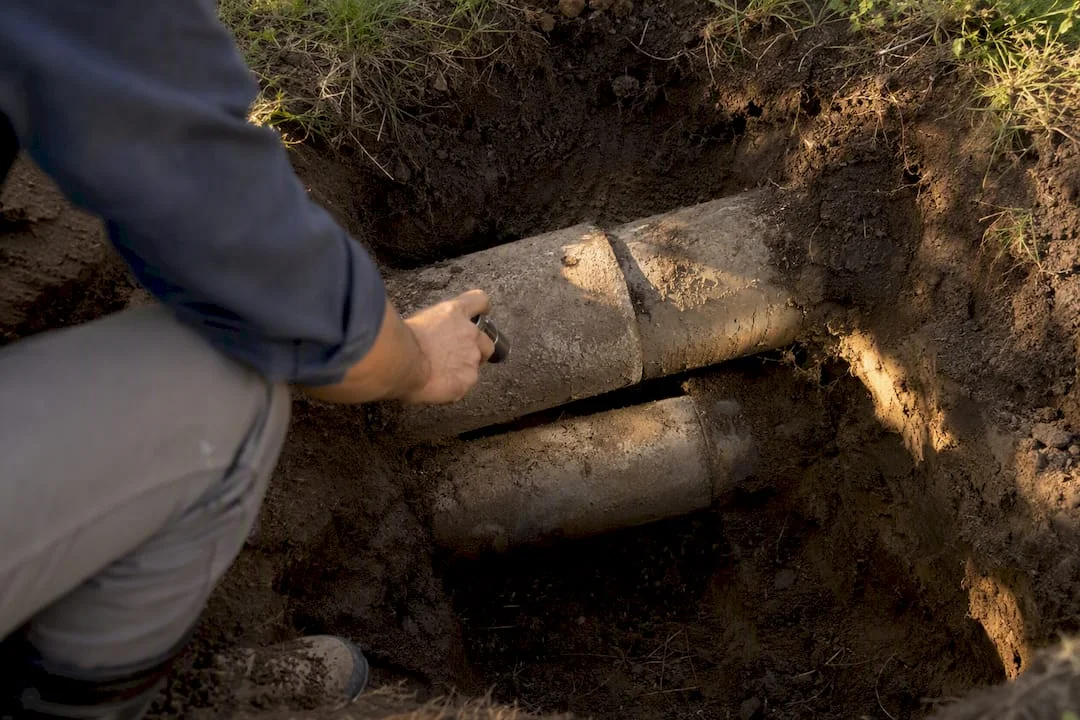
An offset sewer joint happens when two connected pipe segments shift out of alignment vertically or laterally, leaving a step or ledge inside the line that catches debris, slows flow, and gives roots and groundwater a place to get in. Small, stable offsets can often be monitored. A worsening one, or any offset paired with backups or wet spots in your yard, needs professional attention soon.
The right first move isn’t a shovel. It’s an HD camera (CCTV) inspection that shows exactly where the offset sits, how severe it is, and whether roots or infiltration have already moved in. Everything else, including whether you need trenchless lining or full excavation, follows from what that inspection finds.
Before you call anyone, here’s what matters most right now:
- Don’t dig blind. Excavating without knowing pipe depth, offset severity, and utility locations risks making things worse and costing more.
- Get a camera inspection scheduled if you’ve had repeat clogs, slow drains in multiple fixtures, or damp patches in the yard.
- Call a licensed, insured contractor, not a handyman, since sewer work touches structural, health, and sometimes municipal code issues.
Key Takeaways
Offset sewer joint repair starts with an HD camera inspection that grades the defect, since that grade, not guesswork, determines whether trenchless lining, spot repair, or open-trench replacement is the right call.
| Point | Details |
|---|---|
| Diagnose before you dig | Get an HD camera inspection first to see the offset’s exact location, size, and PACP grade. |
| Small offsets can wait | Grade 1 to 2 defects with no active roots or infiltration are often safe to monitor. |
| Watch the 40% threshold | Offsets cutting cross-sectional area by roughly 40% or more usually need pre-treatment before lining. |
| Match method to severity | CIPP and spot repairs suit moderate offsets; open-trench is reserved for collapsed or severely damaged pipe or significant misalignments. |
| Insurance isn’t automatic | Coverage often excludes gradual wear-and-tear, so check your specific policy language before assuming reimbursement. |
| Trenchlessmaine leads with inspection | Trenchlessmaine diagnoses offsets by camera first, then applies CIPP lining, hydro jetting, or spot repair based on what the footage shows. |
Table of Contents
- Offset Sewer Joint Repair: What’s Really Happening Underground
- Common Causes of Offset Sewer Joints
- Warning Signs and How Pros Diagnose an Offset
- What Happens If You Ignore an Offset Joint
- Comparing Your Repair Options for an Offset Joint
- Costs, Timelines, and What Moves the Price
- From Camera Report to Repair Decision: The Professional Process
- Keeping Your Sewer Line Ahead of Future Offsets
- A Contractor’s View on What Actually Surprises Homeowners
- Getting an Offset Joint Fixed the Trenchless Way
- Sources
Offset Sewer Joint Repair: What’s Really Happening Underground
An offset joint is a mechanical misalignment. Picture two sections of pipe that used to line up perfectly at their joint, then one shifted up, down, or sideways relative to the other. That shift leaves a lip or shelf right at the connection point. Every offset sewer joint repair job starts with understanding that this small step does outsized damage over time.
The mechanics are straightforward once you see them. Water and solids moving through the pipe hit that shelf and lose velocity. Solids that would normally flush through settle out and build up. Toilet paper snags on the ledge, grease clings to it, and within a few months you’ve got a partial clog that “clears” with a plunger but keeps coming back. Meanwhile, the gap created by the misalignment is often an entry point. Groundwater seeps in during wet seasons (infiltration), and tree roots, which are drawn to any moisture and oxygen escaping a pipe, find the opening and grow straight into it.
How much this matters depends on how far out of line the pipe is. A joint offset by a small fraction of the pipe’s diameter might barely affect flow. Push that offset further, and you start losing meaningful cross-sectional area. Once the opening narrows enough, the pipe behaves less like a smooth channel and more like a series of small dams, each one collecting sediment and building pressure behind it.
This is exactly why professional inspections use a standardized grading system instead of eyeballing severity. PACP-style grading rates offsets by percent of pipe diameter and assigns a severity grade, which is what determines whether your inspector recommends monitoring or immediate repair.
A Grade 1 or 2 offset with no active roots or infiltration might just get flagged for the next inspection cycle. A Grade 3 or higher, especially with signs of water intrusion, typically triggers a repair recommendation right away.
Pro Tip: Ask your inspector for the specific PACP grade and percent-of-diameter figure, not just a verbal “it’s not too bad.” Numbers on paper matter later if you need a second opinion or file an insurance claim.
Common Causes of Offset Sewer Joints
Most offsets trace back to one of a handful of underground culprits, and knowing which one is likely at play helps your inspector interpret what the camera finds.
- Soil settlement, especially in fill dirt or areas with poor compaction during original construction, lets pipe sections sink unevenly over years.
- Poor bedding or installation, common in homes built before modern trenching standards, leaves pipe without proper support so it shifts under load.
- Tree root pressure, where roots don’t just enter existing gaps but physically push joints apart as they grow near or under the line.
- Freeze-thaw cycles and surface loading, like heavy vehicles or new construction parked over a lateral, that stress soil and pipe repeatedly.
- Groundwater infiltration and soil loss, where water washing soil away from around the pipe removes support and lets segments drop or drift.
Pipe material shapes vulnerability too. Older clay pipe is brittle and prone to cracking at joints under root pressure. Cast iron corrodes and weakens over decades. PVC resists corrosion well but can still shift if the bedding beneath it erodes.
Pro Tip: Before your inspection, walk your yard and photograph any depressions, unusually soggy patches, or a strip of noticeably greener grass tracing the line of your sewer lateral. Sewage acts as an effective fertilizer, so lush growth over the pipe route is often a visible clue pointing straight to a leak.
Warning Signs and How Pros Diagnose an Offset
You’ll usually notice an offset joint through its symptoms long before anyone puts a camera down the line. Recurring backups that clear temporarily with a plunger or snake, slow drainage in multiple fixtures at once (a sign the problem is in the main line, not a single trap), sewage odor near a specific yard spot, and soggy or sunken ground along the pipe route are the classic tells.
CCTV inspection is the primary tool professionals use to confirm what’s going on, and for good reason: it’s the only method that shows the exact location, size, and condition of the offset instead of guessing from surface symptoms.
A technician feeds a waterproof camera through the line and records footage as it travels, stopping at anything unusual. The resulting report typically documents the offset as a percentage of pipe diameter, notes any root intrusion or infiltration at the joint, and assigns a defect grade.

A few supplementary tests come into play when infiltration is suspected but not fully clear from video alone. Smoke testing pushes non-toxic smoke through the system to reveal where it escapes aboveground, pointing to cracks or gaps. Dye testing traces water flow to confirm a suspected connection or leak path. Soil probing and locating equipment help pinpoint depth and position when excavation might be needed.
Pro Tip: Always ask for the annotated camera footage or still images, not just a summary paragraph. A contractor who can show you the defect on screen, point to the PACP code, and explain the grade in plain terms is giving you something you can actually evaluate, and something you’ll want on file if you ever need a second quote or an insurance conversation.
What Happens If You Ignore an Offset Joint
Left alone, a minor offset rarely stays minor. The shelf that starts as a small snag point for debris tends to become a chronic clog site, then roots find the gap and grow into it, and root masses expand into the pipe interior over successive seasons. Infiltration continues washing soil away from around the pipe, which can widen the offset further and, in severe cases, create voids under your yard or even near a foundation or driveway.
- Recurring clogs that no longer respond to plunging or basic snaking
- Root intrusion that thickens over time and eventually blocks flow entirely
- Soil erosion around the leak site, sometimes progressing to visible sinking or small sinkholes
- Sewage contamination risk if the line eventually fails and backs up into the home
Monitoring makes sense for small, stable offsets with no active infiltration or root growth, the kind of Grade 1 or 2 defect your inspector flags for a future recheck. Action becomes urgent once you see active water intrusion, a worsening grade between inspections, or repeated backups in the same period.
One reason trenchless lining has become the default recommendation for many of these cases: properly cured CIPP lining creates a new, jointless interior surface that stops the infiltration cycle driving further soil loss, which is often what turns a stable offset into a worsening one.
Comparing Your Repair Options for an Offset Joint
Not every offset needs the same fix, and this is where a trenchless-first mindset pays off. Trenchless CIPP lining works by pulling a resin-saturated felt tube through the existing pipe and curing it in place, forming a new pipe within the old one with no joints for roots or water to exploit. It handles minor-to-moderate offsets well, especially once root intrusion is cleared and the site is prepped.
Sectional or spot repair targets a single defect location with a localized patch or mechanical sleeve rather than relining the whole run, which suits an isolated problem in an otherwise sound pipe. Pipe bursting replaces the old pipe entirely by fracturing it outward while pulling a new pipe through the same path, useful when the line needs full replacement but you still want to avoid a continuous open trench. Open-trench excavation remains the fallback when the pipe has collapsed or the structural damage is too severe for any lining or bursting method to work safely.
| Repair Method | Best For | Property Disruption | Typical Cost Range | Expected Lifespan | Key Limitations | Typical Timeline |
|---|---|---|---|---|---|---|
| CIPP trenchless lining | Minor to moderate offsets, root intrusion, infiltration | Minimal; access points only, no full-length digging | Moderate | Multiple decades with proper installation | Not suited to collapsed pipe or severe misalignment | Often completed in a day for spot sections |
| Sectional/spot repair | Single isolated defect in an otherwise sound line | Low; localized access | Lower than full lining | Long-term if the surrounding pipe is healthy | Doesn’t address problems elsewhere in the line | Typically one day |
| Pipe bursting | Full-length replacement without continuous trenching | Moderate; entry/exit pits required | Higher than lining | Comparable to new pipe installation | Needs adequate working space at pits | Several days |
| Open-trench replacement | Collapsed pipe, severe structural failure, extreme offsets | High; excavation, landscaping and paving impact | Highest | Comparable to new pipe installation | Requires full dig, backfill, and often repaving | 3 to 5 days depending on access |
Deciding between these options isn’t just about the offset’s size. It also depends on what the camera inspection reveals about the pipe’s overall condition. If the offset reduces the pipe’s usable cross-sectional area by roughly 40% or more, industry guidance under ASTM F1216 calls for pre-treatment or mechanical correction before a liner goes in, since lining over too severe a step risks wrinkling or an uneven cure. That’s a case where a contractor might recommend a hybrid approach: correct the worst section mechanically, then line the rest.
Skipping pre-treatment is one of the more common reasons homeowners hear about a lining job “not holding up” the way they expected.

Costs, Timelines, and What Moves the Price
Cost ranges vary widely by method, and any contractor giving you an exact number before an inspection is guessing. Trenchless lining generally sits in the moderate range since it avoids excavation labor and restoration costs. Sectional spot repairs tend to run lower, given the smaller footprint.
Pipe bursting costs more than lining because it involves full pipe replacement, even without a continuous trench. Open-trench replacement is typically the most expensive option once you factor in excavation, backfill, and restoring driveways, landscaping, or hardscaping disturbed along the way.
Timelines follow a similar pattern. Minor trenchless or spot repairs often wrap up in a single day. Partial replacements generally take two to three days. Full open-trench replacements run three to five days, with variation driven by soil conditions, depth, access to the work area, and whether permits or inspections add scheduling delays.
A few factors reliably push cost and time in either direction:
- Depth of the pipe below grade, since deeper lines mean more excavation or longer access setups
- Pavement, driveway, or hardscape removal required to reach the affected section
- Distance from the house to the street connection, which affects material and labor for longer runs
- Lateral reconnections needed where branch lines tie into the main sewer
- Sewage cleanup if a backup has already occurred before repair begins
- Permitting requirements, which vary by municipality and can add days to the schedule
On the insurance question homeowners ask most often: coverage for sewer line repairs is inconsistent across policies; for insight on how to handle different types of backflow risks and insurance considerations, see this NJ homeowner guide.
Standard homeowners insurance often covers sudden, accidental failures but typically excludes gradual wear-and-tear, which is exactly how most offset joints develop over years. Check your specific policy language, and ask your insurer directly whether an offset caused by long-term settlement qualifies before assuming either way.
From Camera Report to Repair Decision: The Professional Process
Every credible offset sewer joint repair recommendation should follow a logical sequence, and understanding it helps you evaluate whether a contractor’s proposal actually makes sense.
- CCTV inspection locates the offset, measures its severity, and documents any root intrusion or infiltration on video.
- Defect grading assigns a PACP-style grade based on percent-of-diameter offset and observed conditions, separating “monitor” cases from “repair now” cases.
- Pre-treatment assessment determines whether root removal, hydro jetting, or void grouting needs to happen before any lining or structural work.
- Suitability check for trenchless methods, confirming the pipe’s geometry and remaining structural integrity can accept a liner or sectional repair.
- Method selection, where the contractor recommends CIPP, sectional repair, pipe bursting, or open-trench replacement based on everything found in steps one through four.
Before signing anything, ask your contractor for the raw camera footage, the specific defect grade, a written explanation of why they’re recommending a particular method over the alternatives, warranty terms in writing, and a firm timeline with a written estimate.
Pro Tip: Ask directly whether soil voids exist around the pipe and whether the plan includes grouting them after lining. A liner stops water from getting into the pipe, but it doesn’t fill gaps already excavated by prior infiltration, and an unfilled void under a liner can lead to future settling.
Keeping Your Sewer Line Ahead of Future Offsets
A camera inspection every ten years is a reasonable baseline for older sewer lines, sooner if you’ve already had issues or live in an area with mature trees near the lateral. Between inspections, a few habits make a real difference in preventing new offsets from forming.
- Prune roots mechanically near sewer lines rather than relying on root-killing chemicals, which can damage healthy trees and don’t address soil disturbance from root growth.
- Avoid planting new trees or shrubs directly over or near your lateral, since root systems are drawn to the moisture and nutrients a sewer line provides.
- Schedule periodic hydro jetting if you’ve had recurring hairline root intrusion, since it clears buildup before it becomes a full blockage.
- Improve surface drainage around your yard to reduce soil saturation, which lessens the settlement and erosion that cause offsets in the first place.
Pro Tip: Keep every camera inspection report and any before/after footage from past repairs in a dedicated file. It’s the kind of documentation that speeds up warranty claims and gives an insurance adjuster something concrete to work from if a future issue arises.
A Contractor’s View on What Actually Surprises Homeowners
The gap between a camera report and the actual dig site is where most surprises happen. Soil voids that didn’t show up clearly on video, a lateral connection nobody mentioned, or a root mass denser than the footage suggested are common enough that any experienced trenchless crew plans for contingencies rather than assuming the inspection told the whole story.
Validating that trenchless repair is the right call means more than measuring the offset. It means confirming the pipe isn’t collapsed, checking for voids that need grouting after lining, and making sure pre-treatment like root cutting happens before the liner ever goes in.
When you’re evaluating a contractor’s credibility, ask for:
- Installer certification specific to the lining system being used
- Before-and-after camera footage from comparable past jobs
- A written warranty with clear terms, not a verbal promise
Getting an Offset Joint Fixed the Trenchless Way
If everything above has you wondering whether your yard needs to look like a construction site to fix this, it usually doesn’t. Trenchlessmaine handles offset sewer joint repair with HD camera inspection first, then moves to CIPP lining, hydro jetting for pre-treatment, spot repairs, or void grouting depending on exactly what that inspection shows, without defaulting to full excavation unless the pipe genuinely requires it.

That inspection-led approach means less torn-up landscaping, no guessing at what’s wrong underground, and a repair plan built around your pipe’s actual condition rather than a one-size-fits-all quote.
Many jobs finish in a single day, and lining work comes backed by warranty terms that reflect its long service life. If you’ve noticed slow drains, a soggy patch in the yard, or recurring backups, the next step is simple: request a camera inspection and estimate so you know exactly what you’re dealing with before committing to any repair method.
Sources
For deeper technical detail behind the guidance above, these resources are worth a look: NASSCO’s CIPP and offset joint guidance covers pre-treatment thresholds, the Pipeline Rehabilitation Matrix explains defect grading, This Old House breaks down realistic timelines, and Policygenius details insurance coverage variables. If your contractor cites CIPP limitations, ask them to walk you through the NASSCO guidance directly.