

If you’ve ever searched “why did my toilet just erupt” at 2 a.m., you’re not alone — and you’re probably dealing with a sewer backup. It’s one of the most stressful plumbing emergencies a homeowner can face, and in rare cases it can be genuinely dangerous.
Here’s what’s actually happening inside your pipes, why it happens more often than people realize in Maine, and how to protect your home.
Want the full deep-dive? Read our complete homeowner guide: Why Toilets Explode During a Sewer Backup — The Complete Maine Homeowner’s Guide →
What “Exploding Toilet” Really Means
When people say a toilet exploded, they usually mean one of three things:
1. A violent overflow. The most common scenario. Your main sewer line is blocked somewhere downstream — either in your lateral line or out in the city main — and sewage has nowhere to go. Pressure builds, and the lowest fixture in your house (usually a basement toilet, floor drain, or shower) becomes the release valve. Water, sewage, and sometimes debris shoot up through the bowl.
2. Cracked porcelain. If pressure builds fast enough, the water seal in the toilet trap can’t hold. In older or already-stressed fixtures, the pressure can crack the tank or bowl. You wake up to a flooded bathroom and a destroyed toilet.
3. An actual explosion. This is rare but documented. Sewer gas contains methane and hydrogen sulfide — both flammable. If methane accumulates in the trap and encounters an ignition source (a water heater pilot light in the basement, someone lighting a match, even static electricity), it can ignite. People have been seriously injured this way.
Why It Happens in Maine More Than You’d Think
Three local factors make Maine homes especially vulnerable:
- Aging clay and Orangeburg sewer laterals. Many homes built before 1980 still have original sewer pipes. Clay cracks. Orangeburg (a tar-paper pipe used mid-century) delaminates and collapses. Tree roots find every seam.
- Heavy spring runoff and storm surges. When snowmelt or heavy rain overwhelms municipal combined sewer systems, the city main can surcharge — literally back up into your house from the street side.
- Frost heave. Maine’s freeze-thaw cycle shifts pipes, creates bellies (low spots where waste collects), and eventually breaks joints.
If your home is more than 40 years old and you’ve never had your lateral inspected, you’re essentially driving on bald tires.
The Warning Signs Most People Ignore
A sewer backup almost never happens without warning. Here’s what your house is trying to tell you in the weeks before:
- Gurgling sounds from drains when you flush a toilet or run the washer
- Multiple slow drains at once (not just one sink — that’s a clog; several means a main line issue)
- Sewage smell in the basement, especially near the floor drain
- Water backing up into the tub or shower when you flush
- Patches of unusually green or sunken grass over your sewer line
- A toilet that bubbles when the washing machine drains
Any one of these is a reason to call for a camera inspection. Two or more, and you should treat it as urgent.
What to Do If It’s Happening Right Now
- Stop using water immediately. Don’t flush, don’t run the shower, don’t start the dishwasher. Every gallon makes it worse.
- Kill power to the affected area if water is near outlets, the water heater, or the furnace.
- Don’t try to plunge a backed-up toilet hard. If the blockage is in the main line, plunging won’t help and can push contaminated water into other fixtures.
- Open a window. Sewer gas is no joke — ventilate.
- Call a sewer professional, not a general plumber. A standard plumber can clear a clogged toilet. A backup in your main line needs someone with a sewer camera and a jetter.
How We Find the Actual Problem
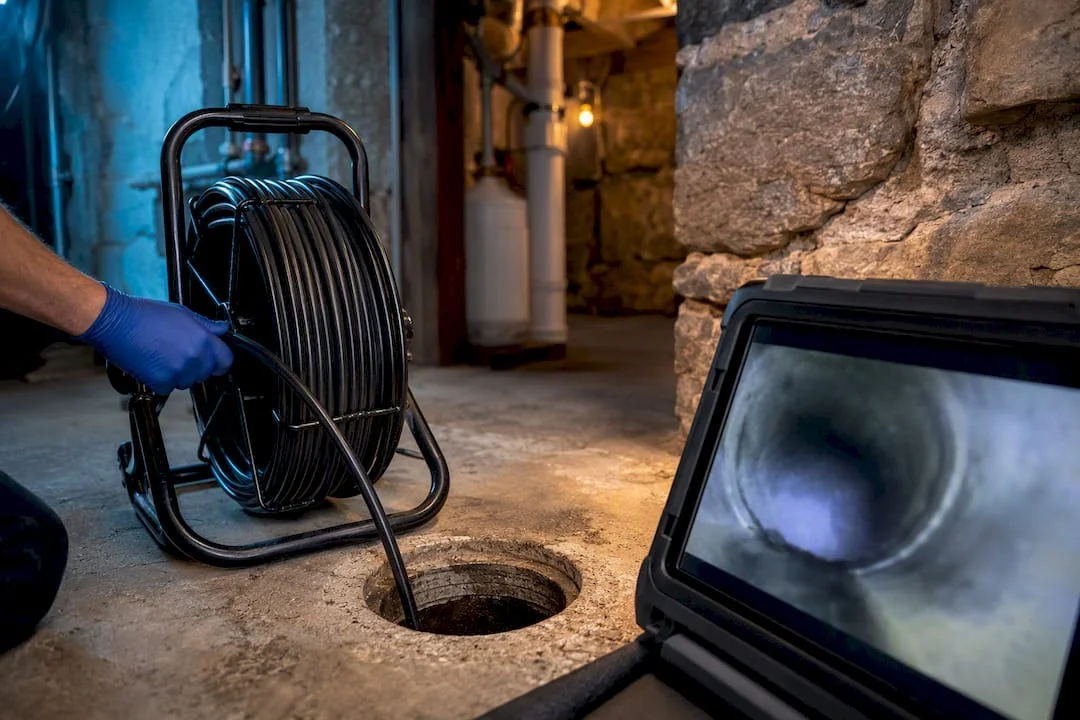
At Trenchless Maine, we don’t guess. Every backup starts with a camera inspection of the lateral line — we send a waterproof camera down the pipe and show you, on a screen, exactly what’s going on. Roots, cracks, bellies, separated joints, foreign objects, the location of a collapse in feet from the cleanout.
That footage does three things:
- Confirms the actual cause (not a guess based on symptoms)
- Locates the problem precisely so no one digs up your yard hunting for it
- Gives you documentation for insurance if the backup caused damage
How to Prevent the Next One

Install a backwater valve. This is a one-way check valve installed on your main sewer line. If the city main surcharges or your lateral blocks downstream, the valve slams shut and prevents sewage from pushing back into your house. For homes in flood-prone or low-lying areas, it’s the single best investment you can make.
Get a camera inspection every 3–5 years if your home is older, has trees near the sewer line, or has had any prior backup history. A $300 inspection can catch a problem before it becomes a $15,000 one.
Fix small issues before they become big ones. Root intrusion can often be cleared and treated before the pipe fails. A small crack can sometimes be lined (trenchless pipe lining) without digging up your yard. A collapsed section caught early is a spot repair, not a full replacement.
Know where your cleanout is. Every homeowner should be able to locate their main sewer cleanout in daylight before they ever need it in the dark.
The Trenchless Difference
Traditional sewer repair meant excavating your lawn, driveway, or basement floor — a project that could take a week and cost more to restore the landscaping than the repair itself. Trenchless methods let us rehabilitate or replace most sewer lines with one or two small access points.
- Pipe lining (CIPP) cures a new pipe inside your old one
- Pipe bursting pulls a new pipe through the path of the old one while fracturing the old pipe outward
- Spot repairs fix a single bad section without touching the rest
Less digging. Less downtime. Less restoration cost. Same or better result.
If You’re Dealing With a Backup Right Now
Call Trenchless Maine. We do camera inspections, emergency clearing, and trenchless repair across Maine. We’ll tell you what’s actually wrong, show you the footage, and give you options — not a one-size-fits-all sales pitch.