
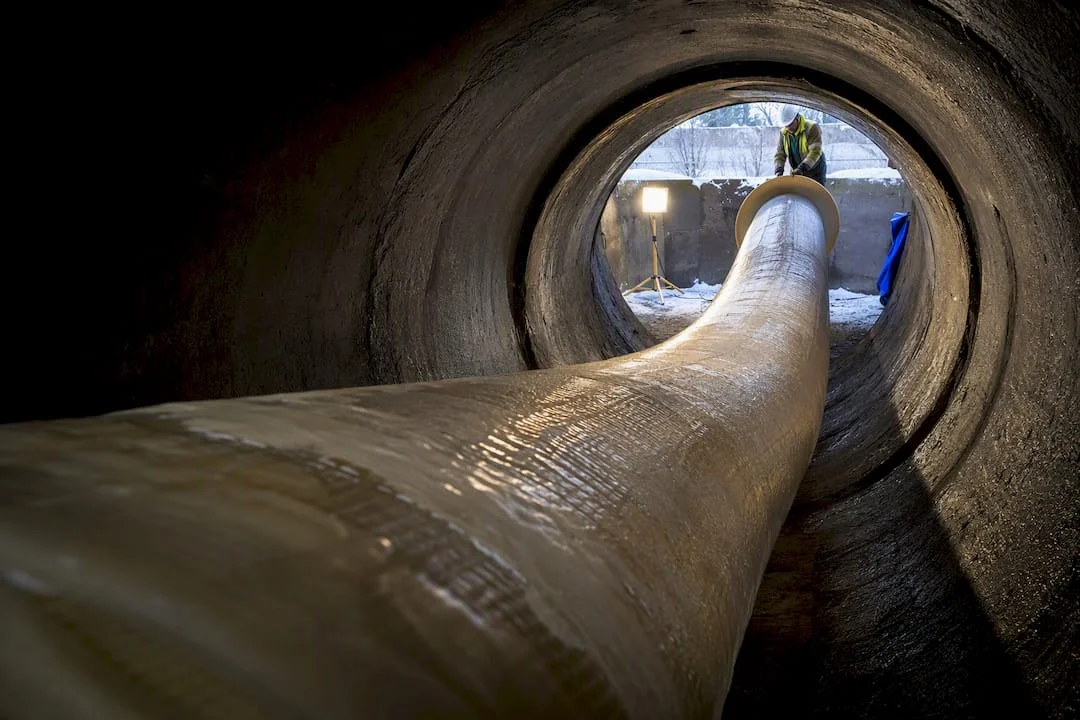
Storm drain lining is a trenchless repair method that installs a new pipe inside the damaged one, restoring flow and structural strength without digging up your property. For most cracked, corroded, or root-infiltrated storm drains, it beats open-cut replacement on cost, speed, and disruption. Before committing to any method, schedule a CCTV inspection to confirm your pipe is a good candidate.
TL;DR:
- Storm drain lining is cost-effective for pipes with cracks, corrosion, or root intrusion, provided the pipe has not fully collapsed or shifted out of alignment.
- Cured-in-place pipe is the primary method used for structural repairs, suitable for diameters up to 100 inches or more, while coatings mainly combat corrosion and minor leaks.
- Proper inspection with CCTV and thorough cleaning are essential, with post-installation verification needed to ensure successful lining and reinstatement of laterals.
- Larger or heavily damaged pipes may require hybrid strategies, combining spot excavation with lining to avoid unnecessary full replacements.
- Contractors should provide detailed project histories, material standards compliance, and clear warranty terms, with storm drain experience preferred over sanitary sewer expertise.
Table of Contents
- What Storm Drain Lining Is and Why Property Owners Choose It
- Common Lining Methods and Where Each One Fits
- Inspection and Cleaning: Confirming a Pipe Can Be Lined
- The Lining Process, Step by Step
- Storm Drain Lining Costs vs. Open-Cut Replacement
- When Lining Makes Sense and When It Doesn’t
- Vetting a Contractor Before You Sign
- How Trenchless Maine Approaches Storm Drain Lining Projects
- Get a Storm Drain Assessment From Trenchless Maine
- Sources
What Storm Drain Lining Is and Why Property Owners Choose It
Storm drain lining works on a pipe-within-a-pipe principle. A contractor inserts a resin-saturated liner into the existing damaged pipe, then cures it in place until it forms a new, jointless pipe wall bonded to the old one. Lining falls into two broad categories: structural, which carries the full load and can stand on its own even if the host pipe fails completely, and non-structural (or semi-structural), which seals leaks and resists corrosion but still relies partly on the original pipe for support.
The appeal for property owners and municipal staff comes down to what you avoid:
- No trenching through parking lots, landscaping, or active roadways
- Traffic and building operations continue with minimal interruption
- Far less soil disturbance and spoil disposal than open-cut digging
- Faster turnaround, often finishing a single reach in a day
- Lower total project cost once restoration and traffic control are counted
Lining has limits, though. A pipe that has fully collapsed, shifted out of alignment, or lost more than a small percentage of its round shape usually needs a spot excavation or full replacement first. Severe bellies (sags that trap standing water) can also make lining impractical until the grade issue gets fixed.
Common Lining Methods and Where Each One Fits
Not every damaged storm drain calls for the same fix. Matching the method to the pipe’s condition, diameter, and access saves money and prevents callbacks.
Cured-in-place pipe (CIPP) is the workhorse of trenchless storm drain lining repair. A felt or fiberglass tube saturated with resin gets pulled or inverted into the host pipe, then cured with hot water, steam, or ultraviolet light until it hardens into a new structural pipe. CIPP handles diameters from a few inches up to 100+ inches or more with segmental systems, and it’s the go-to choice when a pipe needs full structural restoration rather than a cosmetic fix.
Epoxy and spray-applied coatings put down a thin protective layer inside the pipe, usually a few millimeters thick. They’re built for corrosion protection and minor leak sealing, not for pipes with real structural damage. Think of coatings as a maintenance tool for a pipe that’s still sound but starting to pit or corrode, not a repair for cracked or deformed sections.
Sliplining pulls a smaller-diameter pipe (often HDPE or PVC) directly into the damaged host pipe, then grouts the annular space between the two. It’s a solid option when a contractor can access both ends of a run and the diameter reduction won’t hurt hydraulic capacity. The Plastic Pipe Institute’s HDPE repair guidance notes that fusion-welded HDPE joints are generally the preferred repair approach for plastic piping systems, which is part of why sliplining with HDPE has stayed popular for large storm culverts.
Spiral-wound and segmental systems wind interlocking PVC or HDPE strips into place inside the host pipe, which makes them useful for oversized or irregularly shaped culverts where a standard CIPP tube won’t cure evenly. NASSCO’s technical guidance on spiral-wound liners points to growing acceptance of this method across the rehabilitation industry, particularly for large-diameter storm sewers.
Selection ultimately hinges on five factors: pipe diameter, access points, the number and condition of laterals and inlets tying in, how much hydraulic capacity loss you can tolerate, and whether the damage is structural or purely cosmetic.

Pro Tip: Ask your contractor for the annular space calculation before approving sliplining. A liner that’s too small for the host pipe can cut your storm drain’s flow capacity enough to cause backups during heavy rain events.
Inspection and Cleaning: Confirming a Pipe Can Be Lined
You can’t line a pipe you haven’t properly inspected. Skipping this step is the single most common reason lining projects go over budget once work is underway.
- Order a CCTV inspection first. Request a report that documents pipe material, diameter, joint condition, offset joints, cracks, root intrusion locations, and any bellies or standing water. Ask for time-stamped footage tied to distance markers, not just a summary write-up.
- Clean before you assess structural condition. Heavy sediment, grease, or scale can hide cracks and make a pipe look worse or better than it actually is. Hydro jetting handles most debris and light root intrusion; mechanical root cutting or robotic cutting tools are needed for established root masses that jetting alone won’t clear.
- Watch for pipes needing a second cleaning pass. Mineral scale buildup and dense root intrusion sometimes require repeated mechanical cleaning to get the pipe wall clean enough for liner resin to bond properly.
- Flag sections that need a spot repair first. Collapsed segments, major offsets, or crushed pipe usually mean a short excavation before the liner ever goes in, rather than trying to force a liner through a compromised section.
- Require post-installation verification. A completed job should include post-liner CCTV footage, and for structural jobs, documentation of liner thickness and any leakage testing specified in the contract.
The EPA’s Storm Water Management Model supports hydrologic and hydraulic simulation of drainage networks, which municipal engineers sometimes use to confirm that a proposed lining reach won’t create downstream capacity problems once diameter changes are factored in.
The Lining Process, Step by Step
A typical storm drain lining job moves through the same broad sequence regardless of pipe size, though the details shift with diameter and access.
- Site staging and traffic control. Crews set up around existing manholes or catch basins rather than digging trenches, though a busy parking lot or roadway still needs cones, signage, or lane closures during active work.
- Liner insertion. Contractors use one of two methods: inversion, where the liner is turned inside out as it’s pushed into the pipe with water or air pressure, or pull-in-place, where it’s winched through and then inflated against the pipe wall.
- Curing. Hot water or steam cures are common and reliable across resin types. UV curing can shorten the cure cycle and reduce onsite heat exposure, though it demands cleaner surface prep and precise liner fit to work correctly.
- Reinstatement. A robotic cutter re-opens lateral connections and inlet tie-ins from inside the newly lined pipe, restoring every connection that was covered during the lining process.
- Final CCTV verification. A closing camera run confirms the liner cured evenly, laterals are fully reinstated, and no wrinkles or defects compromise flow.
A single lining reach between two manholes often finishes quickly, sometimes within a single work day, according to process descriptions from trenchless contractor guides, though larger diameters or multiple lateral reinstatements can extend that timeline. Municipal projects covering several thousand feet of storm sewer typically get phased across multiple reaches over days or weeks to manage traffic impacts and crew scheduling.
Storm Drain Lining Costs vs. Open-Cut Replacement
Price comparisons that only look at per-foot lining cost miss the bigger picture. The real comparison has to include everything open-cut replacement drags with it.
Primary drivers that push lining costs up include pipe diameter, depth, the number of laterals requiring reinstatement, and how much cleaning a badly scaled or root-infiltrated pipe needs before a liner can go in. A pipe with a dozen lateral connections costs more to line than one with two, simply because of the reinstatement work involved.
Open-cut replacement carries costs that rarely show up on the initial bid: pavement cutting and repaving, landscape restoration, traffic control for the full excavation period, and lost use of a parking lot or drive lane while trenches stay open. A breakdown of trenchless versus excavation costs shows how quickly those restoration line items add up once you total the full project rather than just the pipe work.

When you’re comparing bids, budget a contingency for unexpected findings. Contractors who’ve seen enough storm drains typically price in an allowance for short spot digs discovered during cleaning, since a partially collapsed section sometimes surfaces only after the pipe is jetted clean. Scheduling delays compound this risk. As industry guidance on plumbing project delays points out, every week a project slips adds carrying costs that rarely appear in the original estimate.
Ask contractors to specify contingency terms in writing before signing, including how change orders for unforeseen conditions get priced and approved.
When Lining Makes Sense and When It Doesn’t
Not every damaged pipe is a lining candidate, and pretending otherwise wastes money and delays the real fix.
Good candidates typically share these traits:
- Round or near-round pipe shape with no major structural collapse
- Cracks, corrosion, or root intrusion without significant misalignment
- Accessible manholes or catch basins at both ends of the run
- Hydraulic capacity that can absorb a small diameter reduction
Poor candidates include pipes with full collapse, severe offset joints, or bellies that trap standing water and prevent proper liner cure. A hybrid strategy, spot-digging the worst section and lining the rest of the run, often makes more sense than forcing a full replacement across an otherwise sound pipe.
Operational constraints matter too. A storm drain serving a hospital loading dock or an active manufacturing floor may need off-hours work regardless of which method you choose, and permitting timelines for municipal rights-of-way can shift the calculus. When pipe condition is genuinely unclear from camera footage alone, bring in a structural engineer before committing to either approach.
Vetting a Contractor Before You Sign
The gap between a solid lining job and a costly do-over usually comes down to what you verified before work started, not what happened on site.
- Ask for a portfolio of similar-scale storm drain projects, not just sanitary sewer work. Storm drains carry different flow volumes and debris loads than sanitary lines, and a contractor’s sanitary experience doesn’t automatically transfer.
- Require pre- and post-installation CCTV as a contract deliverable, not an optional add-on. Get the acceptance criteria in writing: what counts as a passing inspection, and what triggers a redo.
- Request material datasheets and standards compliance. Ask which ASTM standards govern the resin and liner system proposed, such as ASTM F1216 for cured-in-place pipe installation, and confirm the contractor can produce documentation, not just a verbal assurance.
- Verify insurance, bonding, and warranty terms in writing. Ask whether the warranty is transferable if you sell the property, and get written maintenance recommendations for after installation.
Pro Tip: Always request project references specifically for storm drainage, not sewer lining in general. A contractor who only shows sanitary sewer photos may not have handled the higher flow volumes and debris loads storm systems throw at a liner.
How Trenchless Maine Approaches Storm Drain Lining Projects
Trenchless Maine builds every storm drain project around the same core toolkit: CIPP lining, hydro jetting for cleaning and prep, HD camera inspections for diagnosis and verification, and drain clearing for pipes that just need debris removed rather than structural repair. That combination lets a single crew handle inspection through final sign-off without bringing in separate subcontractors for each step.
The company offers warranties on qualifying CIPP installations, with terms that vary based on pipe condition and project scope, so confirm the warranty details in writing before signing. Many jobs move quickly, often completing within a short time frame for a standard residential or light commercial reach, which helps keep disruption to a minimum.
Before scheduling, have your property’s access points, any known problem areas, and prior inspection reports ready. That prep speeds up mobilization and gives the crew a clearer picture before the camera even goes in the pipe.
— John
Get a Storm Drain Assessment From Trenchless Maine
If your storm drain is showing cracks, root intrusion, or slow drainage, the fastest way to know your real options is a proper camera inspection, not a guess based on symptoms alone. Trenchless Maine handles that assessment directly, then moves straight into CIPP pipe lining when a pipe qualifies, without bringing in a separate excavation crew or tearing up your parking lot to get there.

For pipes carrying heavy sediment or root masses that need clearing before any lining work can start, Trenchless Maine’s hydro jetting service handles prep in the same visit. And if you’re still weighing lining against full replacement, the team can walk you through what trenchless sewer repair actually involves for your specific property before you commit to either path. Reach out to schedule a CCTV inspection and get a straight answer on whether your storm drain qualifies for lining.