
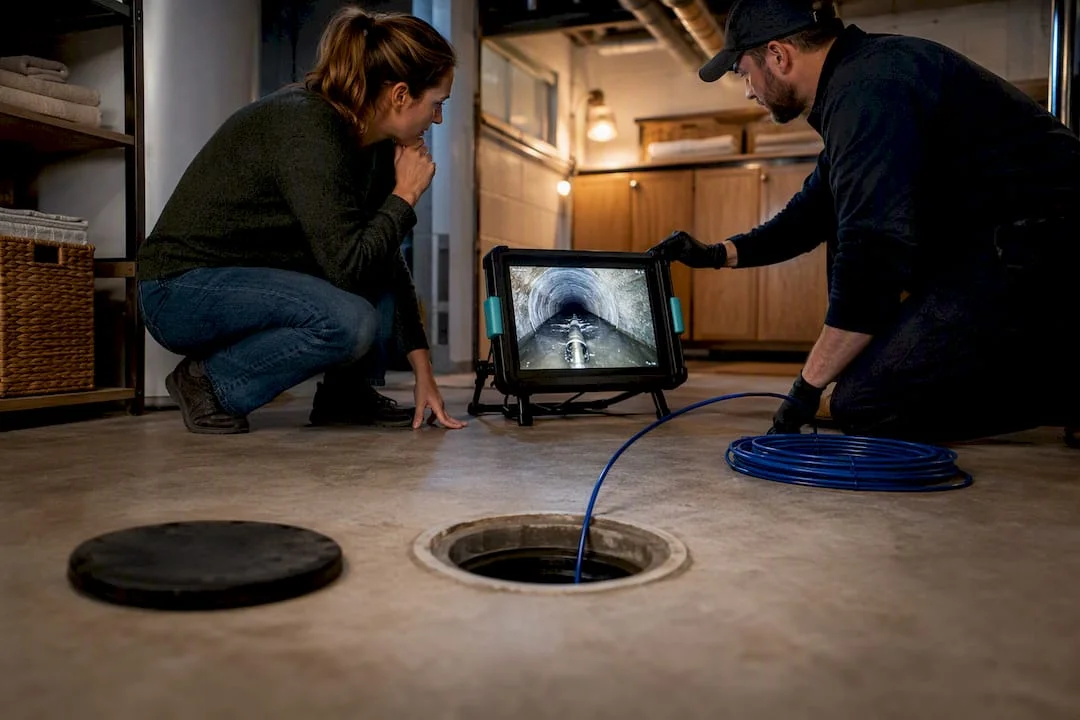
A sewer line belly is serious when it causes recurring backups, and the reliable fix for most bellies is excavation: digging down, regrading the bedding, and replacing the sagging section. Trenchless lining usually can’t correct the slope. Your immediate next step is arranging an HD camera inspection so a contractor can measure the sag and confirm what you’re actually dealing with before any digging starts.
TL;DR:
- Excavation and regrading are the most reliable solutions for sewer line bellies, as trenchless lining cannot correct the pipe slope effectively.
- Camera inspections are essential for confirming a belly, as they identify the exact location, severity, and causes of the sag rather than relying on visual guesses.
- Repairs become more costly if the pipe has extensive damage, multiple problem areas, or deep burying, with typical costs ranging from a few thousand dollars to well over ten thousand.
- Insurance usually does not cover sewer belly repairs unless there is a specific endorsement, so homeowners should document damages and verify coverage beforehand.
- Preventative measures, such as avoiding heavy loads over the pipe, managing roots, scheduling regular inspections, and not relying solely on snaking, can reduce long-term repair costs.
Table of Contents
- What Causes a Sewer Line Belly?
- What Are the Signs of a Sewer Line Belly?
- How Do Contractors Diagnose a Sewer Line Belly?
- Repair Options: Excavation, Trenchless Lining, and Everything Between
- What Does Sewer Belly Repair Cost and How Long Does It Take?
- Will Insurance Cover a Sewer Belly Repair?
- How Do You Choose the Right Contractor for Belly Repair?
- How Can You Prevent a Sewer Line Belly?
- What to Expect From a Reputable Sewer Repair Company
- Common Mistakes Homeowners Make With Belly Repairs
- Ready to Get Your Sewer Line Inspected?
- Sources
What Causes a Sewer Line Belly?
A sewer line belly is a low spot or sag in your underground sewer pipe where wastewater and solids collect instead of flowing straight to the main line. Picture your pipe as a gently sloped hallway. Waste is supposed to travel downhill the entire way. When one section of that hallway dips, everything that passes through it slows down, pools, and eventually leaves solids behind. Over time, that trapped waste narrows the channel further, and what started as a minor dip turns into a chronic clog factory.
Bellies don’t appear randomly. They form because the ground under the pipe shifts or was never properly prepared to begin with.
- Poor bedding or compaction during original installation, leaving soft spots the pipe settles into
- Soil movement, including seasonal freeze-thaw cycles common across Maine winters
- Heavy loads overhead, like a parked vehicle, a new shed, or compacted equipment during construction
- Installation shortcuts, where a contractor skipped proper slope calculations or backfilled incorrectly
- Tree root intrusion, which can shift or crack pipe sections and create uneven settling nearby
The reason a belly gets worse instead of staying static comes down to physics. Once solids start collecting in a sag, that buildup reduces the pipe’s effective diameter. Water still flows, but with less room and less pressure, it carries fewer particles all the way through. Each flush deposits a little more material. What began as an occasional slow drain compounds into a house that backs up every few weeks, no matter how often you snake it.
What Are the Signs of a Sewer Line Belly?
A single clogged drain rarely means you have a belly. A belly announces itself through patterns, not isolated incidents. Here’s how to tell the difference between an ordinary clog and something structural.
- Multiple drains slow down at once. If your kitchen sink, bathtub, and toilet all drain sluggishly around the same time, that points to a shared line problem rather than a localized blockage in one fixture’s trap.
- Toilets gurgle when you run other water. Air trapped behind standing wastewater escapes back up through the nearest opening, usually the toilet, whenever you run the washing machine or shower.
- Clogs return within days or weeks of professional cleaning. Snaking or hydro-jetting clears the accumulated waste but doesn’t fix the underlying sag, so homeowners often pay repeatedly for temporary relief instead of a permanent solution.
- Sewage odor near a specific spot in the yard. Standing wastewater in a low pipe section can seep gas upward through the soil, especially noticeable after rain.
- A patch of unusually green, lush grass running across your yard. Wastewater trapped in a belly acts as an effective fertilizer for whatever sits above it, so a visible strip of thriving grass in an otherwise average lawn is worth investigating.
- Wet or soggy ground with no obvious drainage cause. This often signals a slow leak developing at the low point where pressure and standing water put the most stress on old pipe joints.
Treat this as urgent once you notice two or more of these signs together, particularly repeat backups after a professional cleaning. That combination almost always means the problem is structural, not incidental.
How Do Contractors Diagnose a Sewer Line Belly?
Guessing has no place in sewer diagnosis, and a competent contractor won’t rely on it. A sewer camera inspection is the only reliable way to confirm a belly, because it shows the dip, any standing water sitting in it, and related issues like root intrusion or pipe cracking that a visual guess from the yard could never catch.
A proper diagnostic process typically includes:
- HD camera footage run through a cleanout or accessible fitting, capturing the interior condition, water levels, and the exact location of any sag
- Slope and depth measurement, often using locating equipment paired with the camera’s transmitter to map how far the pipe drops and where
- Length and severity assessment, distinguishing a minor one-foot dip from a multi-foot sag that’s collecting significant debris
- Cleanout access evaluation, checking whether your property has an accessible entry point or whether one needs to be added before inspection
Camera footage matters because it turns a subjective symptom list into an objective diagnosis. Two houses with identical backup complaints can have completely different root causes: one a genuine belly, the other a single root ball at the property line. Reviewing footage directly prevents contractors from recommending an excavation that isn’t needed, or worse, missing one that is.
Pro Tip: Ask your contractor to walk you through the footage in real time rather than just handing you a written summary. Watching the camera reach the low point and slow down in standing water tells you more in ten seconds than a page of notes.
Most contractors access your line through an existing exterior cleanout, though older homes sometimes lack one and need a small access point installed first. That extra step adds modest cost but saves the larger expense of misdiagnosing the problem.
Repair Options: Excavation, Trenchless Lining, and Everything Between
Once you’ve confirmed a belly, the repair method matters as much as the diagnosis. Not every fix on the market actually addresses what’s wrong.
Spot excavation and regrade is the standard for most bellies, and for good reason. Excavation and spot repair means digging to the sag, recompacting the bedding, restoring proper slope, and installing new pipe at the correct grade. This is the only method that touches the actual cause of a belly, which is unstable or poorly prepared soil underneath the pipe. Everything else treats only the symptom.

Full replacement becomes the right call when a camera inspection reveals multiple problem areas along the line, extensive root damage, or a section that’s already collapsed. Trying to patch several failing spots piecemeal usually costs more over a few years than replacing the whole run once.
Trenchless lining (CIPP) has real advantages for cracked, corroded, or root-damaged pipe that still holds its original shape. The liner conforms to the existing pipe’s contours, which means it typically cannot correct the pipe’s slope. Line a belly without addressing the sag first, and you’ve essentially laminated the same sag in a new material. Lining works well as a companion repair when a minor belly sits alongside broader pipe deterioration, but it’s rarely the standalone answer for a genuine slope problem.
Pipe bursting and directional boring fit specific scenarios, mainly full-line replacements where trenching the entire yard isn’t practical. Both methods still depend on establishing correct slope during installation, so they don’t sidestep the soil and grading issue at the heart of a belly.

A few methods marketed for spot repairs, like pneumatic pipe splitting tools sometimes called “gophers,” work best on straight, uniform sections. They’re not typically suited to correcting an established sag.
Contractors verify success the same way they diagnosed the problem: a post-repair camera inspection paired with documentation of the compaction and bedding work performed. That paper trail matters if a similar issue develops years later, and it’s your proof the job was done to spec rather than just backfilled and buried.
Lining alone cannot restore slope on a genuine belly. Any contractor proposing CIPP as a standalone fix for a documented sag should be asked directly how they plan to address the underlying grade.
What Does Sewer Belly Repair Cost and How Long Does It Take?
Cost depends heavily on depth, pipe length affected, and what sits above the repair site. Prices for excavated belly repairs commonly run several thousand dollars for straightforward spot jobs, with full replacements and complicated site access pushing costs higher.
A few factors drive that range:
- Depth of the pipe. A line buried six feet down costs more to reach than one sitting three feet under the surface.
- Material composition. PVC replacement pipe generally costs less than cast iron or clay alternatives some older Maine homes still have in the ground.
- Landscaping and hardscape restoration. Digging through a driveway, mature garden bed, or patio adds both labor and material costs beyond the pipe work itself.
- Permit requirements. Most municipalities require a permit for sewer lateral work, and that fee gets built into your total estimate.
For timeline comparisons between trenchless and excavation methods, a small, single-section spot repair with easy access often completes within one to two days once the crew is on site. Larger jobs involving full replacement, driveway removal, or difficult soil conditions can stretch to a week or more, factoring in inspection, excavation, pipe work, backfill, compaction, and restoration.
Pro Tip: Get your inspection scheduled before you request bids. A camera-confirmed diagnosis lets every contractor quote against the same known problem, which makes comparing estimates far easier than comparing vague guesses.
Will Insurance Cover a Sewer Belly Repair?
Most standard homeowner policies won’t help you here. Standard homeowner insurance generally excludes private sewer lateral repair, which leaves the homeowner responsible for the full cost unless a specific endorsement applies.
- Check for a service-line endorsement or rider on your existing policy before assuming you’re uncovered entirely.
- Document everything for a possible claim, including camera footage timestamped to show the damage and an itemized contractor estimate breaking down labor, materials, and permit costs.
- Confirm permit requirements with your municipality before work begins. Sewer lateral repairs typically require a permit, and licensed contractors generally handle that filing as part of the job.
If you’re buying or selling a home with an aging sewer lateral, that responsibility question becomes part of the disclosure conversation between buyer and seller, since an undiagnosed belly can surface as a costly surprise after closing.
How Do You Choose the Right Contractor for Belly Repair?
The wrong contractor either misses the belly entirely or fixes the symptom while leaving the sag intact. Use this checklist before signing anything.
- Request camera footage, not just a verbal diagnosis. You should see the sag, the standing water, and the surrounding pipe condition yourself.
- Ask exactly how they’ll regrade and compact the bedding. A vague answer here is the biggest warning sign in the entire process.
- Confirm what materials they’re installing and why that material suits your soil conditions and pipe depth.
- Get warranty terms in writing, including what’s covered if the same section sags again within a defined period.
- Ask whether they perform a post-repair camera check to verify the new slope and document the finished work.
- Verify they’re pulling the required permit rather than treating it as optional paperwork.
Pro Tip: If a contractor quotes a full belly repair without ever mentioning soil compaction or slope correction, that’s the clearest sign they’re planning to install a new section without fixing what caused the old one to sag.
Watch for red flags beyond a missing permit mention: extremely low bids with no itemized breakdown, reluctance to show you inspection footage, or a pitch that leads with trenchless lining before anyone has confirmed whether slope correction is even needed.
How Can You Prevent a Sewer Line Belly?
Prevention costs far less than repair, and most of it comes down to consistent, unglamorous upkeep rather than any single fix.
- Keep heavy loads off the sewer path. Avoid parking vehicles, storing equipment, or building structures directly over the lateral line if you know its location.
- Manage tree roots proactively, especially with older lines near mature trees, since root pressure is a repeat contributor to both cracks and settling.
- Schedule periodic camera checks on older pipe, particularly clay or cast iron lines installed decades ago, before a minor dip becomes a full belly.
- Use hydro-jetting on a maintenance schedule rather than only in emergencies, which keeps buildup from accumulating in early-stage sags.
- Keep records of every inspection and repair. A documented history helps you (and future buyers) understand the line’s condition and catch new issues early.
- Never rely on repeated snaking as a long-term strategy. It clears symptoms temporarily and leaves the actual sag exactly where it was.
What to Expect From a Reputable Sewer Repair Company
Some sewer repair providers work across residential, commercial, and municipal properties, offering CIPP lining, hydro-jetting, HD camera inspection, and drain clearing aimed at minimizing disruption to your property whenever the method allows.
A homeowner working with a reputable trenchless and excavation provider should expect:
- Clear camera footage you can actually review, not just a summary of findings
- Honest guidance on whether trenchless lining fits your specific belly or whether excavation is the more durable answer
- Documented warranties covering the completed work
- Before-and-after proof from comparable jobs, available through a project gallery
Ask any contractor you’re vetting for references and visual examples of past belly repairs. A company confident in its work will show you the footage and the results without hesitation.
Common Mistakes Homeowners Make With Belly Repairs
The costliest mistake is paying for repeat drain cleaning without ever demanding camera proof of what’s actually wrong. Snaking a belly feels like progress, but it’s a loop, not a fix. Spend the money once on the correct repair, with proper bedding and slope correction, and you avoid years of recurring emergency calls. What we prioritize, always, is diagnosis first, correct excavation second, and camera verification last, so nobody’s guessing whether the fix actually held.
— John
Ready to Get Your Sewer Line Inspected?
If you’re seeing the signs we’ve covered here, guessing isn’t a strategy. Some service providers offer HD camera inspection paired with an itemized estimate, so you see the exact footage of your pipe’s condition before any decision gets made about excavation, lining, or replacement.

Scheduling is straightforward: request an inspection, and a technician runs the camera through your existing cleanout to locate and measure any sag before recommending next steps. If your situation calls for a repair that preserves your landscaping, trenchless sewer repair may apply depending on what the footage shows. If your line needs routine maintenance rather than a structural fix, hydro-jetting clears buildup without guesswork. Browse the service overview or the project gallery for examples of completed work, then reach out to get your camera inspection scheduled.
Sources
For more on homeowner responsibility and insurance coverage, see Lakewood’s guidance on sewer and water line issues. For a deeper technical explanation of why lining can’t correct slope, see SewerRepairs.com’s breakdown of trenchless myths.
- What Is A Sewer Line Belly? Signs, Causes, And Repair Options – Western Rooter & Plumbing
- What Is a Sewer Line Belly? Causes, Signs & How to Fix It – Repipe Solutions Inc.
- Sewer and water line issues – Lakewood Online
- Sewerrepairs
- Sewer Line Belly Repair for Sagging & Standing Water – HPER Services
Recommended
- In Maine: Use Camera Inspections to Choose a Sewer Repair Contractor
- Sewer camera inspection: Maine homeowner’s guide
- What Causes Sewer Line Failure: a Homeowner’s Guide