
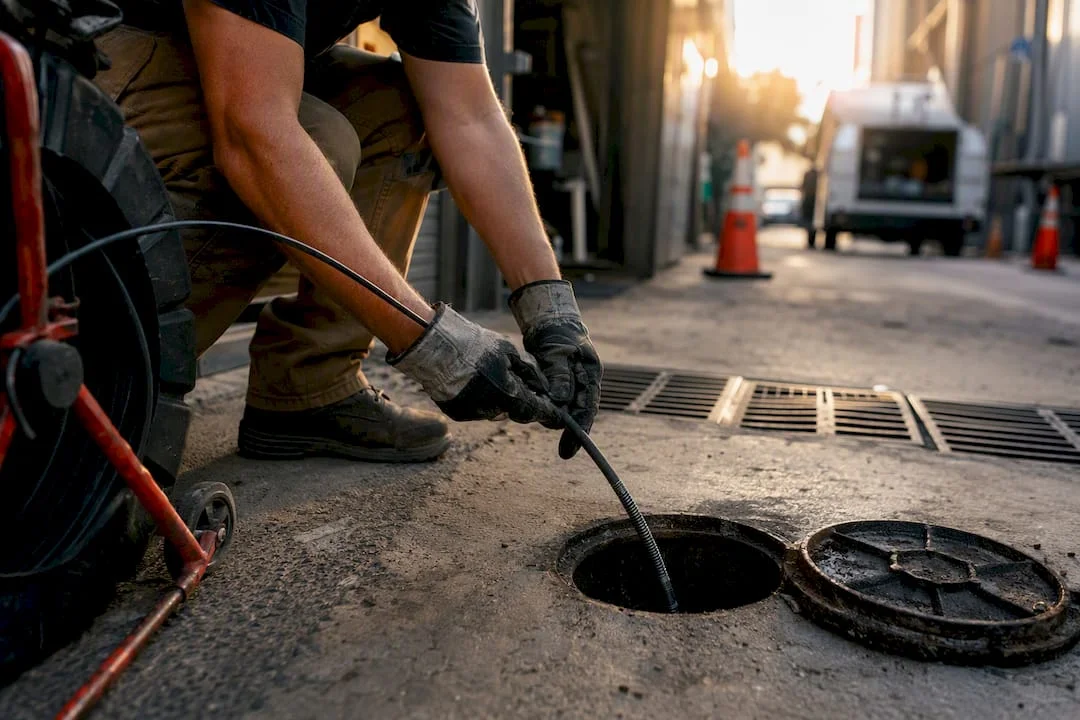
If you suspect commercial sewer pipe root intrusion, your priorities are simple: restore flow, confirm severity with an HD CCTV inspection, then decide between a targeted repair and full trenchless rehabilitation. Do not skip the camera step to save a day, since guessing at severity leads facilities to pay for clearing jobs on pipes that actually need structural work.
In the next 24 to 72 hours:
- Isolate the affected stack or lateral and reduce discharge from that area if fixtures are backing up.
- Call a licensed sewer contractor for emergency jetting or mechanical cutting to restore flow immediately.
- Request HD video evidence of the line before any repair work begins, not just a verbal assessment.
Before the crew arrives, gather the location of the lateral, recent discharge patterns from affected fixtures, and any landscaping, construction, or heavy rain in the past month. Roots cause more than half of all sewer blockages nationally, and that single statistic is why “just snake it and move on” is rarely the right long-term answer for a commercial line.
Key Takeaways
Commercial sewer pipe root intrusion requires HD CCTV confirmation before choosing between mechanical clearing and permanent trenchless rehabilitation like CIPP lining.
| Point | Details |
|---|---|
| Confirm before you clear | Run HD CCTV before committing to a repair method, since roots enter through existing leaks, not intact pipe. |
| Sequence remediation correctly | Cut or jet to restore flow first, then apply chemical inhibitors only during low-flow periods afterward. |
| Watch for pattern signals | Three or more emergency clearings on one lateral within a year signals a structural issue, not bad luck. |
| Budget for the real cost | Recurring emergency clearing often runs more expensive over time than a single trenchless repair. |
| Trenchlessmaine’s role | Trenchlessmaine combines HD camera diagnostics, hydro jetting, and warranty-backed CIPP lining to resolve root intrusion with minimal property disruption. |
Table of Contents
- Why Do Tree Roots Invade Commercial Sewer Pipes?
- What Are the Warning Signs of Root Intrusion in Commercial Systems?
- How Do Professionals Diagnose Root Intrusion?
- What Temporary Fixes Restore Flow Fast?
- Does Chemical Root Treatment Actually Prevent Regrowth?
- Which Long-Term Repair Fixes Root Intrusion for Good?
- What Maintenance Plan Prevents Roots From Coming Back?
- How Much Does Root Intrusion Repair Cost and How Long Does It Take?
- What Regulatory and Safety Rules Apply to Root Intrusion Work?
- What Should You Require From a Trenchless Contractor?
- A Field Perspective on Managing Commercial Root Intrusion
- How Trenchlessmaine Handles Root Intrusion for Commercial Properties
- Frequently Asked Questions
- Sources
Why Do Tree Roots Invade Commercial Sewer Pipes?
Roots do not go looking for pipes to destroy. They chase oxygen, moisture, and nutrients, and a leaking or loosely jointed sewer line offers all three in concentrated form. A municipal sewer authority in Michigan explains that root hairs are drawn to water vapor escaping through cracks or loose joints, then follow that vapor trail straight to the opening.
Here’s the detail most facility managers miss: roots almost never create the initial defect. They exploit one that already exists, whether that’s a hairline crack, a shrinking gasket, or a joint that shifted during backfill settling. Extension research on residential and commercial lines alike confirms roots exploit existing leaks and gaps rather than boring through intact pipe. A single root tip finding that gap can widen it within a season, then mat with grease and debris until the line chokes, according to Forest Service research on root intrusion mechanics.
Some materials and installation styles are far more exposed than others:
- Older clay tile pipe has mortar or oakum joints every few feet, each one a potential entry point.
- Corroded cast iron develops pinhole leaks as it ages, especially in older commercial buildings built before the 1970s.
- Poorly joined bell-and-spigot PVC can leak at the gasket if installation was rushed or the pipe wasn’t properly bedded.
- Modern solid-core PVC with fused or properly sealed joints resists intrusion far better simply because there are fewer gaps to find.
Site conditions matter as much as pipe material. Shallow cover, loose or poorly compacted backfill, and fast-growing species like willows or silver maples planted near a lateral all raise risk substantially. Soil that stays well-oxygenated, common in sandy or loamy fill, also encourages more aggressive root growth toward buried lines than dense clay soil does.
What Are the Warning Signs of Root Intrusion in Commercial Systems?
Commercial buildings show root intrusion differently than single-family homes, mostly because of scale. A backup in a multi-floor building often shows up as a partial drain issue on one floor while another floor functions normally, which makes the problem easy to underestimate until it isn’t.
Watch for these indicators across your fixtures and grounds:
- Slow drains affecting multiple fixtures at once, not just one isolated sink or toilet.
- Recurring clogs that clear temporarily after a plunge or a service call, then return within weeks.
- Gurgling sounds from toilets or floor drains, especially chest-level drains in mechanical rooms or basements.
- Foul sewer odor near floor drains or in areas with limited ventilation.
- A strip of unusually green, lush grass or a soft, wet spot running across the lawn above the lateral line.
- Lift stations or sump pumps over-cycling, or headworks load climbing without a corresponding change in building occupancy.
Grease-laden flows from a commercial kitchen accelerate the matting process once roots are present, since roots and grease combine into a blockage far denser than either alone. Log every service call, the fixture or floor involved, and the resolution method. If your maintenance contract includes response-time SLAs, that log becomes your evidence when a contractor argues a pattern justifies structural investigation rather than another round of clearing.
How Do Professionals Diagnose Root Intrusion?
Diagnosis starts at the cleanout, not the toilet. A technician locates the nearest access point, confirms it’s clear enough for equipment, then runs an HD camera through the line to document what’s actually happening below grade.
The standard workflow looks like this:
- Locate and access the cleanout or lateral connection point.
- Run a preliminary check to confirm the line is passable for camera equipment.
- Complete a continuous HD CCTV run through the affected section.
- Score the severity using PACP-style defect descriptions, from minor root hair intrusion to structural breach.
- Provide a written recommendation tied to that severity score.
When a contractor hands you a report, it should include more than a verbal summary. Require these deliverables in writing:
- Continuous, unedited video of the full run, not selected clips.
- Defect codes or plain-language descriptions at each problem point.
- Distance markers or chainage so you know exactly where along the line each defect sits.
- Still images capturing the root intrusion points clearly.
- A written recommendation on urgency and repair approach.
Severity interpretation matters more than most managers realize. A hairline root intrusion at a single joint is a monitoring item. Roots occupying more than half the pipe’s cross-section demand action soon. A structural breach, meaning displaced joints or a partially collapsed section, moves you straight past mechanical clearing into rehabilitation territory, a distinction industry diagnostic standards treat as the line between routine maintenance and capital repair.
What Temporary Fixes Restore Flow Fast?
When a commercial line is actively backing up, you need flow restored today, and that means choosing between mechanical cutting, hydro jetting, or a combination of both, depending on what’s actually in the pipe.
Mechanical root cutters and augers physically shred root masses using rotating blades on a flexible cable. They work well for dense, woody root intrusions but leave debris in the line that needs to be flushed out separately. Hydro jetting uses high-pressure water, typically in the 1,500 to 4,000 PSI range for commercial lines, paired with a root-cutting nozzle to slice through roots and scour the pipe wall clean in the same pass. For heavily grease-fouled commercial lines, jetting alone often outperforms cutting because it clears the buildup roots have trapped, not just the roots themselves.

The order matters. Cut or ablate the root mass first, then jet to flush the debris; running these steps in the wrong sequence leaves loose material to re-settle and cause another clog within days, a sequencing point plumbing trade guidance stresses for commercial-scale jobs specifically.

For active backups threatening operations, temporary bypass pumping can keep a building functional while the permanent fix is scheduled, particularly for facilities that can’t tolerate any service interruption.
Pro Tip: Undersized cable or the wrong nozzle diameter for your pipe size leaves a narrow channel through the root mass rather than clearing it fully, which means the “fix” fails again within a month. Confirm your contractor is matching equipment to your actual pipe diameter, not using whatever’s on the truck.
Temporary clearing is the right call when CCTV shows root intrusion without significant structural damage. It’s the wrong call when video reveals a collapsed section, severe grade displacement, or joints that have shifted out of alignment, since cutting through roots in a structurally failing pipe just buys a few more weeks before the next emergency call.
Does Chemical Root Treatment Actually Prevent Regrowth?
Chemical root control has one job: slow regrowth after mechanical clearing. It is not, and should never be treated as, a fix for an active blockage. If your line is backed up right now, chemicals won’t move that water. Mechanical cutting or jetting comes first, every time.
Once the line is clear, common preventive agents include:
- Foaming herbicides that coat the full pipe circumference for even contact with remaining root tissue.
- Copper sulfate treatments, though these carry stricter discharge restrictions in many jurisdictions.
- Dichlobenil-based products, applied as a growth inhibitor rather than a root killer.
Timing determines whether treatment works at all. Apply during low-flow periods, typically overnight for a commercial building, so the product stays in contact with root tissue long enough to be absorbed rather than getting flushed through before it can act.
Before scheduling any chemical application, check your local pretreatment ordinances. Discharge into a municipal system is regulated, and EPA guidance on system care notes that improper chemical use can affect downstream treatment processes, which means your facility could face compliance issues even if the treatment successfully controls roots. Facility management guidance increasingly treats chemical treatment as one leg of a three-part preventive strategy, paired with inspection and mechanical cleaning rather than used alone.
Pro Tip: Ask your vendor for the product’s EPA registration and safety data sheet before the first application, then keep it on file. If your local sewer authority ever asks what went down your line, you want that answer ready in thirty seconds, not thirty days.
Which Long-Term Repair Fixes Root Intrusion for Good?
Repeated emergency clearing feels cheaper in the moment, but for a commercial line with a confirmed structural issue, the math flips fast. A single structural rehabilitation often costs less over a few years than the accumulated cost of quarterly emergency calls, lost fixture access, and pump strain from recurring blockages, and cost research on root intrusion puts recurring removal costs at roughly one-sixth the cost of full replacement per incident, a gap that closes quickly once you’re paying it three or four times a year.
Your main options, roughly in order of increasing disruption:
Structural rehabilitation becomes necessary once CCTV shows persistent entry points at multiple joints, visible joint displacement, or any collapsed section, thresholds diagnostic industry guidance flags as the point where repeated clearing stops being cost-effective. For most commercial properties in that position, trenchless CIPP lining offers the strongest balance: it addresses the root cause across the full pipe length, avoids tearing up a parking lot or building slab, and typically carries a warranty that spot repairs simply can’t match.
Slip-lining is worth considering as an alternative on longer runs where a full CIPP cure isn’t practical, and it’s worth understanding how slip-lining compares technically before your contractor recommends one over the other. Open-cut replacement remains the right call only when the pipe has failed structurally beyond what any lining method can restore, since no liner can substitute for pipe that no longer holds its shape.
What Maintenance Plan Prevents Roots From Coming Back?
A one-time repair without a follow-up plan is how facilities end up back in the same spot two years later. Build your cadence around severity history, not a generic annual reminder.
- Schedule CCTV inspection annually for any line with a confirmed history of root intrusion, until structural repair resolves the source.
- Set hydrojetting cadence based on grease load and prior clog frequency, commonly every 6 to 12 months for kitchen-heavy commercial lines.
- Apply chemical root inhibitor treatment on a fixed schedule after each mechanical clearing, not as a standalone measure.
- Review landscaping near the lateral route annually, before planting season.
Your maintenance contract or in-house SLA should specify response times for backups, who documents each incident, and what evidence gets collected, matching the same CCTV and photo standards used for the original diagnosis. That consistency is what turns a maintenance log into leverage during warranty claims or capital budget discussions.
On the grounds side, follow “right tree, right place” principles when selecting or replacing landscaping near sewer routes, guidance the Arbor Day Foundation frames around keeping fast-growing species and aggressive root systems well clear of buried utilities. Root barriers installed during any excavation work, along with properly compacted backfill, both reduce the odds of a repeat intrusion at the same location. For a deeper walkthrough of prevention tactics, protecting sewer lines from root intrusion covers the landscaping side in more detail.
How Much Does Root Intrusion Repair Cost and How Long Does It Take?
Cost swings widely based on a handful of factors: pipe diameter and length, how hard the line is to access, depth below grade, how much structural damage exists, whether traffic control or right-of-way permits are needed, and disposal requirements for excavated material.
Rather than fixed quotes, think in ranges and know which variables push you toward the higher end:
- A diagnostic CCTV inspection is typically the smallest line item, but pricing scales with pipe length and access difficulty.
- A single temporary clearing job (cutting or jetting) costs less than lining but doesn’t resolve structural issues.
- Hydrojetting for commercial mains costs more than residential jobs due to larger diameters and higher flow volumes.
- Trenchless CIPP lining is priced per linear foot and generally costs less than open-cut replacement per linear foot, though severe access issues can narrow that gap.
Timeline follows a similar pattern. Diagnosis typically takes a single site visit. Temporary clearing can often happen same-day in an emergency. Trenchless lining projects commonly complete within 24 to 72 hours of mobilization once scope is confirmed, a turnaround research on recurring root removal costs suggests is a major reason lining outpaces excavation-based repair on total cost of ownership for repeat offenders. Open-cut replacement takes considerably longer once you factor in permitting and surface restoration. Emergency work always costs more than scheduled work, since after-hours mobilization and rush permitting both carry premiums your procurement team should plan for in advance.
What Regulatory and Safety Rules Apply to Root Intrusion Work?
Before authorizing any intervention, confirm what your local sewer authority requires. Pretreatment rules can restrict which chemicals you’re allowed to discharge, copper sulfate being a common flashpoint, and any excavation touching a right-of-way likely needs a road-closure or access permit.
On-site safety isn’t optional paperwork, either:
- Confined-space protocols apply anytime staff or contractors enter a vault, manhole, or below-grade access point.
- PPE requirements differ for jetting crews (eye and hearing protection, waterproof gear) versus chemical application crews (respiratory and skin protection).
- Lockout procedures must isolate any pump before service work begins nearby.
- Traffic control plans are required for any excavation near parking lots, loading docks, or public roadways.
Notify your environmental compliance officer and operations lead before chemical application or excavation work begins, and loop in the municipal sewer authority ahead of any work that could affect the public system, particularly for CIPP curing that generates styrene odor or heat.
What Should You Require From a Trenchless Contractor?
Get everything below in writing before signing a contract, not verbally promised during the walkthrough.
- Full CCTV video, with PACP-style or descriptive severity notes tied to specific distances along the line.
- A written scope of work and itemized quote, broken out by task rather than a single lump sum.
- A project schedule with access requirements clearly listed for each phase.
- Copies of any required traffic control or right-of-way permits.
- Before-and-after documentation plus written warranty terms for the completed work.
On qualifications, ask directly about HD camera resolution and capability, which CIPP standards the crew follows (look for ASTM references specifically), warranty length, insurance coverage limits, and references from comparable commercial projects, not residential ones. Your contract should tie acceptance to the CCTV evidence, not a verbal “looks good,” and should spell out what happens if a lined or repaired section fails within the warranty period.
A Field Perspective on Managing Commercial Root Intrusion
Every commercial root intrusion job comes down to the same tension: the building needs to keep operating while the pipe underneath it gets fixed. That’s the lens worth applying to every decision here, more than any single technique or product.
The mistake facilities repeat most often is treating each backup as an isolated event instead of pattern data. Three emergency clearings on the same lateral in eighteen months isn’t bad luck. It’s a structural line telling you it needs rehabilitation, not another visit from the root cutter. Facilities that catch that pattern early and move to trenchless lining tend to see the service calls stop almost entirely, along with the pump strain that comes with recurring backups.
What tends to work best isn’t picking one method and sticking with it. It’s sequencing them correctly: mechanical clearing or jetting to restore flow immediately, CCTV to get honest evidence of what’s actually happening in the pipe, and structural lining when that evidence says the problem is bigger than roots alone. Skipping the camera step to save a service call is the single most expensive shortcut a facility manager can take, because it turns a documented, defensible repair decision into a guess.
How Trenchlessmaine Handles Root Intrusion for Commercial Properties
If your facility is cycling through emergency clearing calls on the same lateral, the fix isn’t another auger pass. It’s replacing the guesswork with evidence and a permanent solution, which is exactly where Trenchlessmaine’s approach differs from a break/fix plumbing contract: every job starts with HD CCTV inspection so you see the actual severity before committing to a repair method, not after.

For active blockages, Trenchlessmaine runs hydro jetting to restore flow fast and clear grease and root debris in the same pass. When the camera evidence shows structural wear that clearing alone won’t solve, Trenchlessmaine moves to CIPP trenchless lining, completed through existing access points with minimal disruption to your parking lot, tenants, or daily operations, and often finished within 24 hours of mobilization. Every project includes warranty paperwork and before-and-after video documentation your facility can keep on file for insurance or capital planning records. For properties tired of the same recurring service call, request a camera inspection and get a straight answer on whether you’re looking at a repair or a permanent fix.
Frequently Asked Questions
How fast does root intrusion get worse once it starts?
It depends on the defect size and moisture levels, but a small root hair intrusion can expand into a significant blockage within a single growing season if left unaddressed, since the root tip continues widening the entry gap as it grows.
Can hydro jetting alone fix commercial sewer pipe root intrusion permanently?
No. Jetting clears the immediate blockage and flushes debris, but it doesn’t repair the underlying leak or gap that attracted the roots in the first place, so regrowth is likely without a structural fix or ongoing chemical maintenance.
Is CIPP lining strong enough for commercial-diameter pipes?
Yes, CIPP lining is engineered for a range of pipe diameters used in commercial and municipal systems, and it’s applied through existing access points without excavating the pipe route.
Will my insurance cover root intrusion repair costs?
Coverage varies significantly by policy and whether the damage stems from a sudden event versus gradual deterioration, so review your commercial property policy language and consult your carrier before assuming coverage either way.
How often should a commercial property schedule sewer camera inspections?
Properties with a confirmed history of root intrusion should schedule annual CCTV inspections until structural repair resolves the source; properties with no history can typically extend that interval, though local soil conditions and pipe age both affect the right cadence.
Sources
For technical depth beyond this guide, the Forest Service review on root intrusion costs breaks down blockage frequency and repair economics in detail. The Facility Management preventive maintenance guide covers scheduling frameworks for larger property portfolios, while PM Engineer Magazine explains equipment sizing for mechanical and hydrojetting work.
- Tree root intrusion in sewer systems: A review of extent and costs | US Forest Service Research and Development
- Tree Root Intrusion: Drain Cleaning and Removal Methods | Drain Cleaning Authority
- Tree Root FAQ | Sewer and Water