
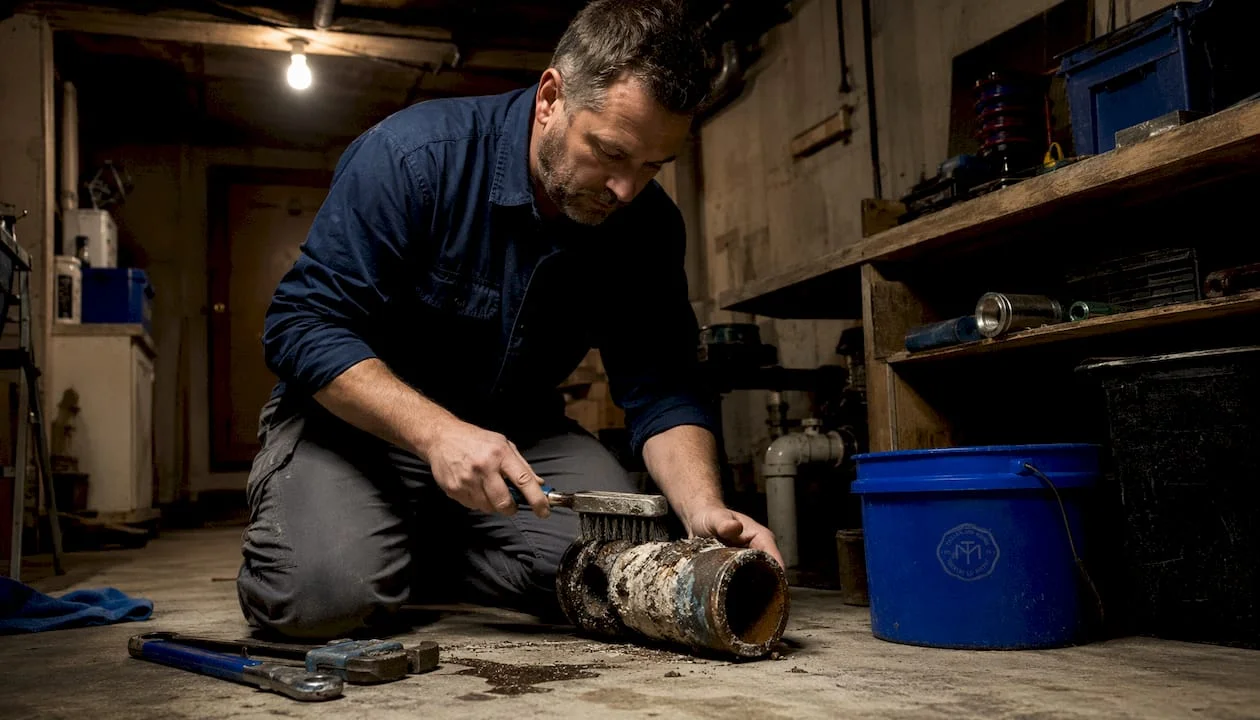
Pipe descaling removes hardened mineral deposits, rust, and heavy buildup from the interior walls of your sewer and drain lines to restore full diameter and flow. You need it when symptoms keep coming back, not when you have a single slow drain after a holiday dinner. If any of the following apply, descaling is likely the right conversation to have with a licensed plumber:
- Drains in multiple fixtures are slow at the same time
- Gurgling sounds come from walls or floor drains after flushing
- Water from taps runs discolored or carries a metallic smell
- Pressure has dropped noticeably over several months
- A mechanical snake clears the line, but the problem returns within weeks
If you recognize two or more of those patterns, skip the store-bought drain cleaner. Schedule a camera inspection first.
Table of Contents
- What pipe descaling actually removes from your lines
- Signs your plumbing system needs descaling
- Which pipes are most vulnerable to scale buildup
- How each descaling method works, and the risks involved
- What a professional descaling job looks like from start to finish
- What descaling typically costs and how often you need it
- DIY vs. hiring a professional: where the line is
- When descaling alone is not enough
- Key Takeaways
- Why pairing descaling with relining is the smarter long-term call
- Trenchlessmaine brings camera-confirmed descaling and relining to Maine homeowners
- Useful sources and further reading
What pipe descaling actually removes from your lines
Scale is not the same as a soft clog you can push through with a plunger. It is a hardened layer that bonds to the pipe wall over time. The three main contributors are:
Mineral deposits (calcium and magnesium) precipitate out of hard water and crystallize on pipe interiors. In regions with high mineral content in the water supply, this process is continuous and cumulative.
Iron oxides and tuberculation form on cast-iron and galvanized steel pipes as the metal corrodes. Rust creates a rough, pitted surface, and that texture accelerates further mineral adhesion. The result is a thick, uneven crust that can reduce a four-inch pipe to an effective opening of two inches or less.
Grease and organic matter do not harden the same way minerals do, but they bind to existing scale layers and trap debris. Over time, the combined mass becomes nearly as rigid as concrete.
What separates scale from a transient clog is permanence. A soft clog moves or dissolves. Scale stays, grows, and eventually causes structural stress on the pipe wall itself.

Signs your plumbing system needs descaling
A single slow drain after a heavy-use weekend is rarely a scale problem. The signal to pay attention to is a pattern across your system. Experts identify chronically slow drainage, gurgling noises, and discolored water as the primary indicators of systemic scale buildup rather than an isolated blockage.
Watch for these specific signs:
- Recurring clogs in the kitchen sink, bathroom drains, or floor drains that return within days or weeks of clearing
- Slow drainage in multiple fixtures at the same time, which points to a shared line rather than a localized obstruction
- Gurgling or bubbling sounds in walls or from nearby fixtures when water drains elsewhere in the house
- Reduced water pressure at faucets or showerheads that has worsened gradually over months
- Rusty, brown, or cloudy water especially after the system has been idle overnight
- Sewage odors from drains, which can indicate buildup trapping organic material
- Frequent sewage backups in basement floor drains or the lowest fixtures in the home
The key distinction between a one-off clog and systemic scale is the pattern. A single event in one fixture is usually a localized blockage. When multiple fixtures are affected, or when the same drain clogs repeatedly after clearing, the problem is almost certainly further down the line and structural in nature.
Pro Tip: Before spending money on repeated snaking, ask a plumber to run a camera through the line. A pre-service inspection takes 20–30 minutes and tells you whether you are dealing with soft debris, hard scale, root intrusion, or pipe damage. That information changes the entire treatment plan.
Which pipes are most vulnerable to scale buildup
Not all pipe materials accumulate scale at the same rate, and knowing what you have affects both the urgency and the method of treatment.

Cast iron and galvanized steel are the highest-risk materials. Cast-iron pipes are especially prone to tuberculation because corrosion creates a rough interior surface that mineral deposits cling to aggressively. Most homes built before 1980 have cast-iron sewer laterals and drain stacks, making them prime candidates for descaling. Galvanized steel supply lines face a similar problem, with rust flaking inward and narrowing the bore.
Copper pipes develop a thin mineral film over time but are far less prone to the thick tuberculation seen in iron. Light chemical descaling is sometimes used on copper, but aggressive mechanical methods are not appropriate.
PVC and modern plastic pipes have smooth interiors that resist adhesion. Scale can still form if water chemistry is extreme, but it is far less common and rarely reaches the severity seen in older metal systems.
For most homeowners in Maine, the pipes most likely to need descaling are the cast-iron sewer laterals and drain stacks that have been in service for several decades. If you are unsure what material your lines are made of, a camera inspection will confirm it quickly and guide the choice of descaling method.
How each descaling method works, and the risks involved
Successful descaling depends on matching the method to the pipe condition. Experienced technicians often combine approaches for severe buildup. Here is how the main methods compare:
Mechanical descaling uses rotating chain knockers or carbide-tipped heads driven by a cable machine. The tool spins inside the pipe and physically scrapes hardened scale from the wall. It is the most effective approach for thick, concrete-like mineral concretion in metal pipes. The risk is real: overly aggressive mechanical action on weakened cast iron can crack pipes or damage joints, so pressure settings and torque control require an experienced hand. This is not a method homeowners should attempt.

Hydro-jetting delivers high-pressure water through specialized nozzles that cut and flush scale simultaneously. When paired with descaling nozzle heads, hydro-jetting handles both heavy grease and mineral buildup in a single pass, making it a preferred choice for severe combined deposits. It is generally safer for pipe joints than mechanical chain tools, but it still requires a camera inspection first to confirm the pipe can handle the pressure.
Chemical descaling applies acidic or citric solutions to dissolve deposits. It works best on light-to-moderate scale or in areas where mechanical access is limited. The critical caution: chemical descalers can accelerate corrosion on some metals if misapplied, particularly on already-thinned cast iron. Environmental disposal is also a consideration. Flushed acidic solution must be neutralized before it enters the municipal system, and a licensed technician will handle that step correctly.
Electronic or magnetic descalers are devices installed on supply lines that claim to alter the charge of mineral ions and reduce adhesion. They may slow re-accumulation in mild hard-water situations, but they do not remove existing scale. Think of them as a maintenance aid, not a cleaning tool.
Key safety and environmental points to keep in mind:
- Chemical descaling requires adequate ventilation; fumes from acidic solutions are hazardous in enclosed spaces
- Flushed scale and chemical residue must be disposed of properly, not simply discharged without treatment
- Mechanical and hydro-jetting work generates debris that flows downstream; a post-service flush and camera check confirms it cleared completely
- Always ask your technician about their disposal process before work begins
What a professional descaling job looks like from start to finish
A well-run pipe descaling process follows four clear stages. Knowing them helps you ask the right questions and verify the work was done correctly.
- Pre-service HD camera inspection. A technician feeds a camera through the line to document the type, location, and severity of buildup. This footage establishes a baseline and determines which method is appropriate. Never allow descaling work to begin without this step.
- Method selection. Based on the camera findings, the technician chooses mechanical heads, hydro-jetting, chemical treatment, or a combination. Pipe material, scale thickness, and pipe condition all factor into this decision.
- Execution. The technician works through existing cleanout access points, which means no excavation is required in most homes. The line is descaled in sections, flushed, and cleared of loosened debris.
- Post-service camera inspection. A second camera pass documents the cleaned interior and confirms the line is clear. This footage is your proof of work and your baseline for future maintenance.
Before hiring, ask your plumber these questions:
- Are you licensed and insured for sewer and drain work in Maine?
- What pipe material experience do you have, specifically with cast iron?
- How many linear feet do you expect to clean, and what access points will you use?
- Will you provide pre- and post-service camera footage in a format I can keep?
- What follow-up prevention do you recommend after the job?
Requesting pre- and post-service camera footage is a practical quality-control step that also preserves documentation for future warranty discussions or insurance claims.
What descaling typically costs and how often you need it
Pricing varies considerably based on severity, pipe length, access conditions, pipe material, and your geographic market. The table below reflects general market estimates for residential work in the United States; actual quotes will depend on your specific system.
| Scenario | Approximate Cost Range | Recommended Frequency |
|---|---|---|
| Single drain line, light scale | — | roughly five years |
| Main sewer lateral, moderate scale | — | roughly five years |
| Main sewer lateral, heavy scale + hydro-jet | — | After clearing; recheck in 1–2 years |
| Descaling + camera inspection (both) | — | As needed based on camera findings |
| Descaling + CIPP relining (combined job) | — | One-time; lining lasts decades |
The biggest cost drivers are access (homes without cleanouts require more labor), the combination of methods needed, and whether the camera inspection reveals damage that requires relining or repair. A job that starts as a descaling visit can expand if the technician finds cracked pipe sections or root intrusion.
Without a protective measure after descaling, scale typically returns within roughly five years, depending on water hardness and usage. Installing a water softener or pairing descaling with an epoxy or CIPP lining extends that interval significantly. For kitchen drain lines with heavy grease use, annual enzyme treatments between professional cleanings are a practical preventive step.
DIY vs. hiring a professional: where the line is
Some maintenance steps are safe for homeowners to handle. Most descaling work is not.
What you can safely do yourself:
- Use a standard mechanical snake to clear hair and soft debris from bathroom drains
- Apply enzyme-based drain maintenance products monthly to slow organic buildup in kitchen and bathroom lines
- Install a mesh drain screen to reduce debris entering the line
- Test your water hardness with an inexpensive kit and consider a water softener if results are high
What requires a licensed professional:
- Mechanical descaling with chain knockers or carbide heads on any pipe, especially cast iron
- Hydro-jetting at any pressure level (wrong pressure on a weakened pipe causes immediate damage)
- Chemical descaling with acidic solutions (handling, application, and disposal require training)
- Any work on the main sewer lateral or lines deeper than a few feet from a fixture
Red flags that mean you should call a pro today, not next week:
- Slow drains in three or more fixtures simultaneously
- A drain that re-clogs within two weeks of being snaked
- Cracking or popping sounds when water drains
- Visible rust staining or flaking around cleanout caps
- Any sewage backup in a basement or ground-floor drain
Attempting hydro-jetting or mechanical descaling without the right equipment and training is one of the fastest ways to turn a $600 cleaning job into a $6,000 pipe replacement. The pipe cleaning techniques used by professionals are calibrated to your specific pipe condition. Guessing at pressure or torque settings on aging cast iron is a genuine structural risk.
When descaling alone is not enough
Descaling restores flow, but it does not fix a structurally compromised pipe. Technicians consistently note that descaling without a follow-up structural assessment can leave a homeowner with a clean but weakened pipe. If the camera inspection after descaling reveals any of the following, you need more than a cleaning:
- Deep pitting or wall thinning from years of corrosion, which leaves the pipe vulnerable to collapse under normal ground pressure
- Root intrusion that has penetrated joints or cracked sections; cutting roots clears the line temporarily, but they return unless the entry point is sealed
- Offset or separated joints caused by ground movement or soil settlement
- Ongoing active corrosion that will re-scale the pipe faster than a normal interval
In these situations, the practical options are:
Descaling + trenchless CIPP relining. After the line is cleaned, a cured-in-place pipe liner is installed inside the existing pipe. The liner bonds to the interior wall, seals cracks and joints, blocks root re-entry, and creates a smooth new flow surface. CIPP pipe lining is non-invasive, typically completed in a day, and carries warranties measured in decades. This is the most cost-effective long-term solution for cast-iron systems that are structurally compromised but still in place.
Full pipe replacement. Reserved for pipes that have collapsed, severely offset, or deteriorated beyond what a liner can bridge. Replacement costs significantly more and involves excavation, but it is sometimes the only option.
Without a protective measure like epoxy lining or a water softener, mineral adhesion commonly returns within about five years. Pairing descaling with relining eliminates that cycle entirely for the lined section.
Pro Tip: When a contractor recommends pairing descaling with relining, ask for the warranty in writing. A reputable provider will back CIPP lining with a multi-decade guarantee and provide pre- and post-service camera footage as part of the job documentation.
Key Takeaways
Pipe descaling is a maintenance procedure, not an emergency fix. Scheduling it before symptoms become severe keeps costs lower and options wider.
| Point | Details |
|---|---|
| Scale vs. clogs | Scale is hardened mineral and rust bonded to pipe walls; it does not clear with a plunger or standard snake. |
| Camera inspection first | Always require a pre-service camera inspection to confirm scale type, severity, and pipe condition before any method is chosen. |
| Cast iron is highest risk | Homes built before 1980 with cast-iron drain lines need descaling most often; aggressive methods require an experienced technician. |
| Descaling + relining extends life | Pairing a cleaning with CIPP lining seals the pipe and prevents scale from returning on the lined section. |
| Trenchlessmaine covers Maine | Trenchlessmaine provides camera inspection, hydro-jetting, descaling, and CIPP relining across Maine with warranties up to 50 years. |
Why pairing descaling with relining is the smarter long-term call
Most homeowners think of descaling as the finish line. After years of seeing what comes next on camera, the cleaner pipe is really the starting point.
A freshly descaled cast-iron line looks dramatically better on camera. Flow improves immediately. But that same camera footage often shows pitting, thinned walls, and joints that have been under stress for decades. A clean pipe with compromised walls is still a pipe that can fail. The scale was actually doing some of the structural work, filling voids that corrosion had opened. Remove it, and those voids are exposed.
That is why the most durable outcome is descaling followed by a CIPP liner. The liner does not just prevent re-scaling on the lined section. It reinforces the pipe wall, seals every joint, and blocks root re-entry. You get a smooth interior that drains freely and a structural shell that extends the pipe’s service life by decades. The pipe lining process is non-invasive, typically completed without digging up your yard, and the warranty documentation gives you something tangible to show a future buyer or insurer.
The homeowners who get the best value from descaling are the ones who treat it as step one of a two-step process, not a standalone fix. If your contractor does not mention a post-cleaning structural assessment, ask for one.
Trenchlessmaine brings camera-confirmed descaling and relining to Maine homeowners
Slow drains and recurring backups in Maine homes often trace back to aging cast-iron sewer laterals that have been accumulating scale for 30 to 50 years. Trenchlessmaine handles the full sequence: HD camera inspection to document what is actually in the pipe, hydro-jetting with descaling heads to clear it, and CIPP relining when the camera reveals structural issues that cleaning alone will not solve. Every job includes pre- and post-service camera footage so you can see exactly what was done. Warranties run up to 50 years on lined sections, and most jobs are completed without excavation, often within 24 hours.

If your drains are slow, your pressure has dropped, or you have had repeated backups, the right first step is a camera inspection. Trenchlessmaine serves most of Maine’s cities and towns. Check whether your address is in the service area and request an inspection estimate, or go directly to the hydro-jetting service page to learn what a high-pressure cleaning involves and what to expect on the day of service.
Useful sources and further reading
The following sources were used to support the facts and guidance in this article. They are also recommended reading if you want to go deeper on any specific topic.
- What Is Pipe Descaling? Causes and Process Explained — practical overview of what descaling removes and the primary indicators that a system needs it
- The Pipe Descaling Process: A Step-by-Step Homeowner’s Guide — detailed breakdown of the four-stage professional workflow and method selection criteria
- What Is Pipe Descaling and When Do You Need It? — material-specific guidance on cast iron vs. PVC vulnerability
- Pipe Descaling for Cast Iron Drains — best practices and chemical cautions for older metal pipe systems
- Pipe Descaling — prevention recommendations and the case for pairing descaling with protective lining
- CIPP Pipe Lining Maine — Trenchlessmaine’s cured-in-place pipe lining service for Maine homeowners
- Trenchless Sewer Services Maine — full overview of camera inspection, hydro-jetting, and relining services available across Maine
- Cast Iron Pipe Lining Explained — specific guidance on no-dig relining for older cast-iron systems